Sarah Vecere
I participated in the Voices Through Time: Stories of Care crowdsourced project by transcribing handwritten records from the UK’s Foundling hospital archive. The project is run by the children’s charity Coram and funded by The National Lottery Heritage Fund.
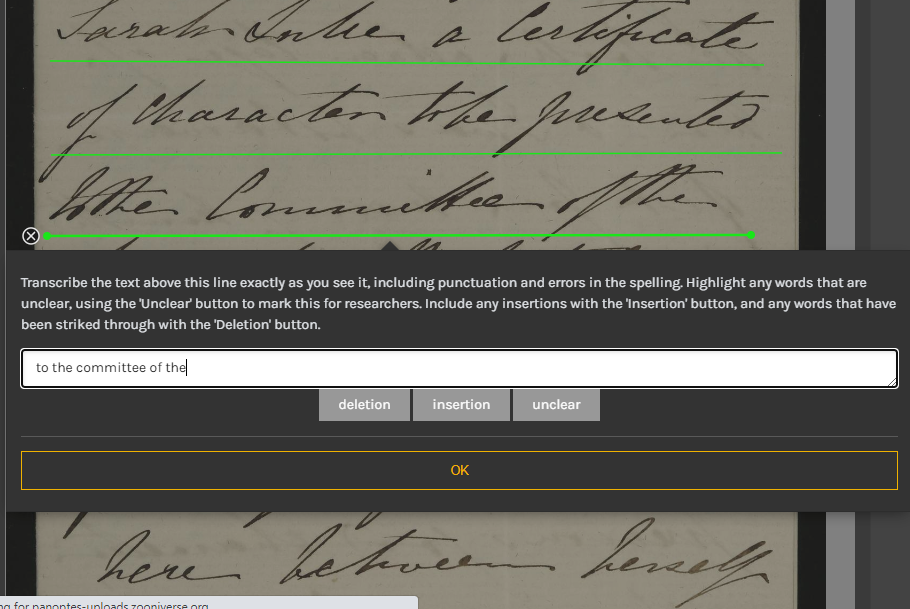
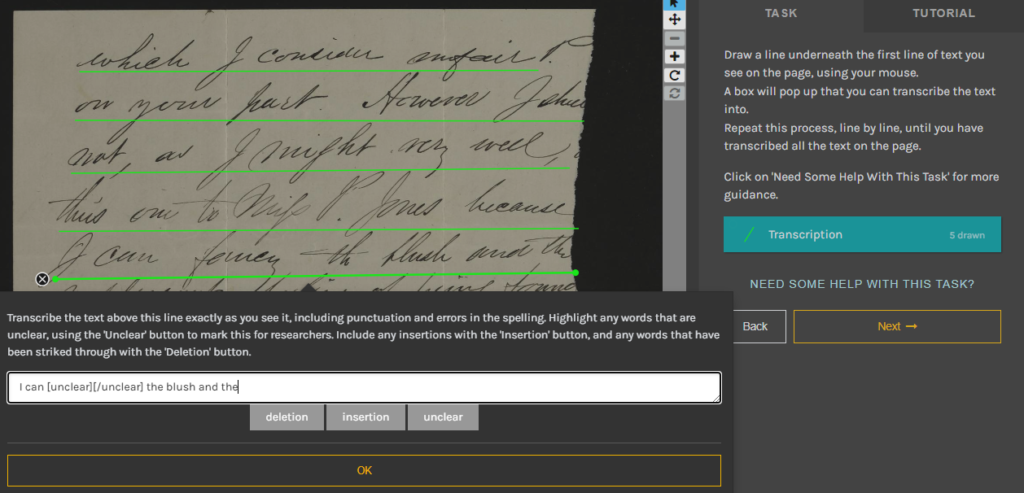
Coram uses the Zooniverse web portal to solicit crowd participation. The project is introduced with a brief historical introduction, a statement of how many untranscribed, handwritten records are in the archive, and an appeal for help. The project is compelling by virtue of its nature – a “foundling” hospital where mothers could leave babies they couldn’t care for. The project appeals to the reader’s desire to help make historical records pertaining to marginalized women available for free on the internet. The exclamation point-heavy pitch also points out how much the participant will enjoy learning about this historic institution. To the extent that one can judge from the user comments, this project most likely appeals to women and history buffs.
Due to the difficulty of reading handwritten records, interpreting historical handwriting patterns, and the inability to discern certain things, such as proper names, from context clues, there is definitely some ambiguity in the information I supplied. The project provides a tutorial with guidelines for reading handwriting from as far back as the 18th century and has a tool for indicating when a portion of the record is unclear. I had the option to add tags, but they were not required. There is a welcome section, a help section, and a message board where participants can interact with other users.
To participate in the project, one must register through the Zooniverse platform then join the Voices Through Time project. The project information makes clear that participants need no special skills and can dedicate as little or as much time as they’d like. Each page is transcribed three times, presumably by three different users, collated, and sample checked by the project team before being uploaded to the final transcription archive. This ensures that they end up with the best possible transcription and takes some of the pressure off of the volunteers. I did feel better knowing that I did not have sole responsibility for the pages I transcribed.
The introduction to the project stressed the importance of verbatim transcription and that the records contained sensitive and possibly triggering content. Links to helpful resources were provided, in the event that any of the content did lead to a need for emotional care or support. There were terms and conditions, but, honestly, I didn’t read them, as I assumed they were the usual privacy related notifications.
Based on the superficial research I performed, most museum crowdsourcing related to digital content seems to be transcribing records. This looks like a daunting task for museums and archives. The project I participated in is only at 20% completion and they hope to be done in 2024. I understand why institutions such as this one need volunteers. Transcription is tedious work, and they can’t possibly have enough paid staff to do it.
Using volunteers for this type of work seems fairly low risk, especially if multiple people work on each document. Mistakes will be made, but that holds true for professionals as well. There is a leap of faith involved in assuming that volunteers are compelled to help out of genuine interest and a desire to contribute to the historical record.
Our in-class discussion on relying upon volunteers did open my eyes to possible problems, though. If items and their associated metadata are added to a digital collection that is available for reuse, any errors could be widely spread. Historical record does require a high degree of accuracy. In our last assignment, I did notice an error in the description of the image I selected for my project. It was inconsequential but, nevertheless, incorrect. Additionally, as a few people brought up in our discussion, crowdsourcing allows institutions to benefit from free labor, which may have a negative impact on paid staff and the profession as a whole. On the other hand, being able to use volunteers for very particular tasks frees up time for GLAM professionals to concentrate on higher level work.
Crowdsourcing seems like a great way for museums to engage audiences. The opportunity to contribute to something meaningful is very appealing and seems likely to encourage return visits to the institution’s digital collection, if not its physical space.

Leave a Reply
You must be logged in to post a comment.