by Amanda Stinchcomb
I began this assignment by conducting research about which institutions were utilizing crowdsourcing initiatives. There were a few journal articles about how cultural heritage institutions were incorporating crowdsourcing into their research, but there were only a few institutions listed at the top of my query results, so I decided to see what open projects were available on Zooniverse.
For anyone unfamiliar, Zooniverse is a website that allows users to participate in scientific research projects from across a variety of fields and topics. Citizen scientists can join volunteers who assist researchers in analyzing data, discovering new phenomena, and contributing to advancing knowledge.
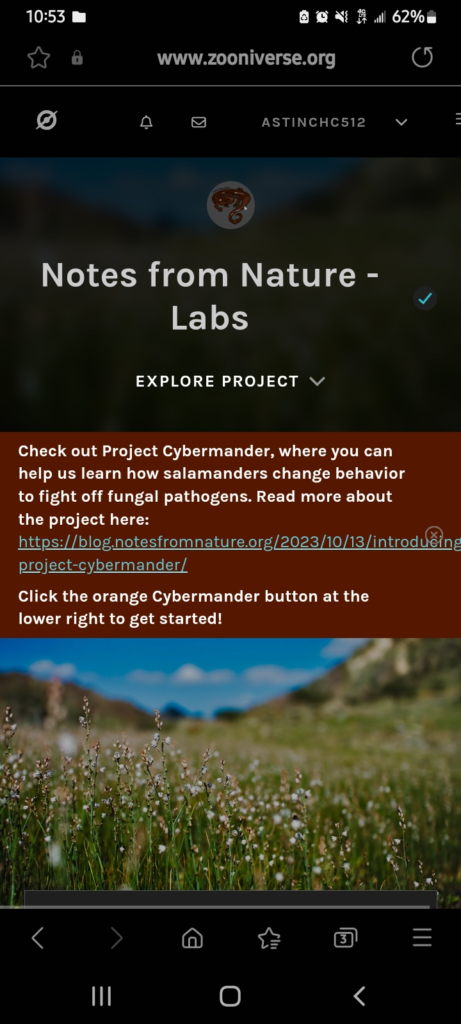
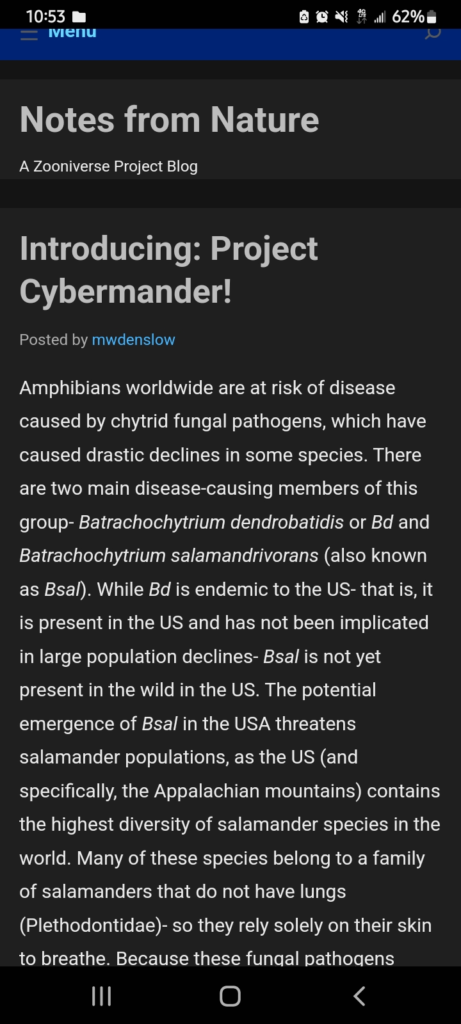
Being an animal lover, the Project Cybermander logo caught my eye. Clicking the logo brings interested individuals to the main project page. The page addresses volunteers with a bold yellow banner running across the top of the page soliciting aid in helping researchers understand how salamanders adapt their behaviors to ward off fungal pathogens. This is the research project currently being conducted by Nature-Labs. Users are directed to click on the logo to begin.
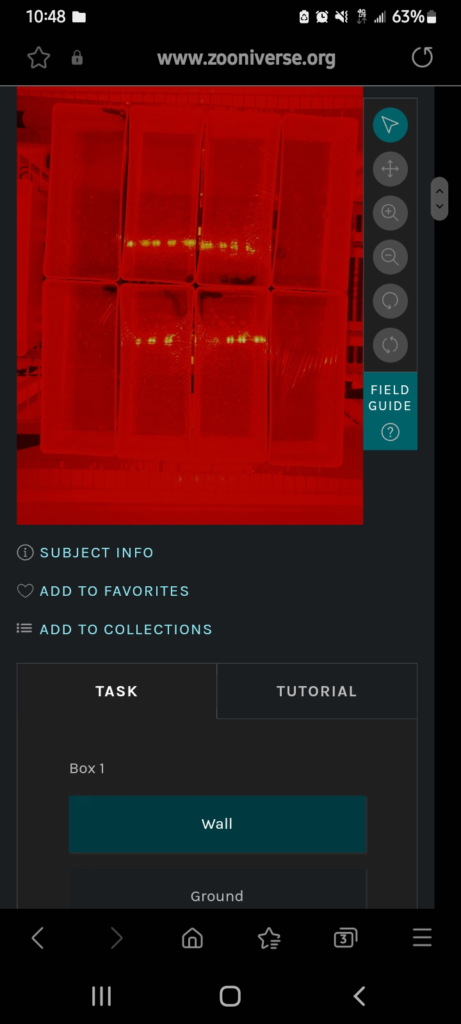
Because this is a visual project, only sighted participants would be able to participate. Still, because of the simplicity of the contribution, even a child of nine to twelve could contribute to the Cybermander II research. It is not clear what the target age range is for this project. Participants are given a brief tutorial before contributing their research. The tutorial acts as a guide for workflow practices. The tutorial notifies users that salamanders are housed in several boxes, eight to be precise. All of the boxes are numbered. If there is a space next to a numbered box, it should be counted as if the box is there. Users are looking to see if the salamanders are on the wall, on the ground, or not visible. The user chooses the number and presents their opinion of where the salamander is located in the box.
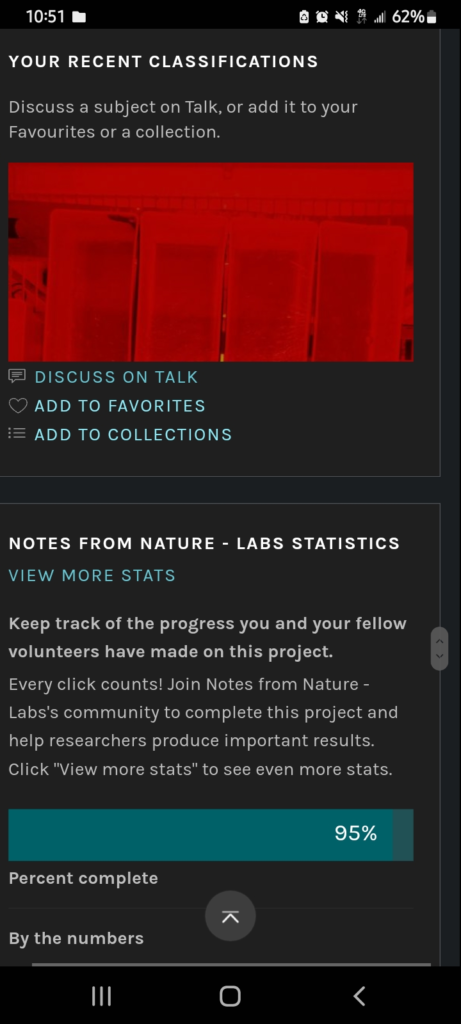
There is some ambiguity in the information provided in my responses because the images are not high-resolution. The salamanders are obscured by the red light, which appears to be coming from heat lamps. Even if users attempt to respond to the best of their ability, there is a margin of error in responses. If users need assistance with the task, they can reference the tutorial which is listed as the second heading next to the task column. There is also a zoom feature that users can utilize, but as I mentioned before, the images are not high-resolution, so the zoom feature is not entirely helpful. Users must also click through the zoom in and out features versus being able to use pinch to zoom, which I feel would be an advantage.
There is an option to view a field guide, but it is not what I expected. The information provided in the field guide is related to using the highlighter tool, OCR correction, using the polygon tool, OCR evaluation, and label finders. I think that the field guide should provide information about the subjects of the research in addition to any tools that users might need to understand related to specific tasks. Interested users can access image metadata by clicking on the “ⓘsubject info.”
Zooniverse mitigates risks associated with projects by only including tasks that can be accomplished by non-experts in the field. Individuals who wish to participate must sign up for an account but are not required to enter specific credentials into their profiles. On the About page, one of the headings specifies that “anyone” can be a researcher. The emphasis is placed on contributions made through observations made about images and videos. The fact that citizen scientists are not required to have “specialized background, training, or expertise,” does leave room for error in observations (Notes From Nature – Labs | Zooniverse – People-powered Research, n.d.). Lack of context, experience, and the framework that typically constructs a career in one’s chosen field could skew results slightly. I imagine the hope is that the data gleaned from these projects is extremely valuable in spite of the margin of error. The Zooniverse site mentions the human skill of pattern recognition as something that is nuanced enough that computers may not be able to pick up certain similarities. It also mentioned the time and resource saving aspect of utilizing volunteers. Obviously, “many hands make light work” and thus, the benefits to humanity through published papers and also significant discoveries that have been made through this public research is sizeable.
Zooniverse focuses on the measurability of results from research conducted by citizen scientists. That is where the published research papers come in to play. These research projects also provide open-source data sets. The discussion boards feature of the research is where many of the research discoveries are made. These boards provide many opportunities for volunteers to communicate with research teams. Volunteers can communicate with researchers via “quick hashtagging to in-depth collaborative analysis.” (Notes From Nature – Labs | Zooniverse – People-powered Research, n.d.).
This course has exposed me to my first experience with crowdsourcing. I did not know anything about how it was being used in cultural heritage institutions. I had heard the term citizen scientists before, but I always thought it referred to individuals who were interested in conducting research on their own terms for the expansion of their own knowledge and not for an organization or institution. From what I can tell, is that some cultural heritage institutions are building crowdsourcing initiatives on the notion that volunteering for these projects includes an element of fun. There is a focus on framing crowdsourcing as more of a leisure activity versus labor. I admit, I did find it enjoyable to contribute to the salamander research project. Although it was a simple task, I did feel some satisfaction after completing the task. Christina Argostino says it very well in her article about Museum Crowsourcing as Playful Labour, “the user’s work is harnessed through activities that sit between work and leisure, and the museum gains in capital and legitimisation, while the user is paid in subjectification, affirmation and intellectual currency” (Agostino, 2015). I see the benefits of reducing overall error and the expansion of knowledge, but there is a fine line in crowdsourcing between knowledge creation and exploitation. I think museums will need to take a good hard look at their policies that address crowdsourcing. They will need to place an equitable lens on their vision and mission statements to ensure that they are conducting this research in a mindful and ethical manner and taking a firm stand against exploitation.
Agostino, C. (2015). Crowdsourcing en el museo como entretenimiento productivo. ICOFOM Study Series, 43a, 23–37.
https://doi.org/10.4000/iss.545Notes from Nature – Labs | Zooniverse – People-powered research. (n.d.). https://www.zooniverse.org/projects/md68135/notes-from-nature-labs

Leave a Reply
You must be logged in to post a comment.