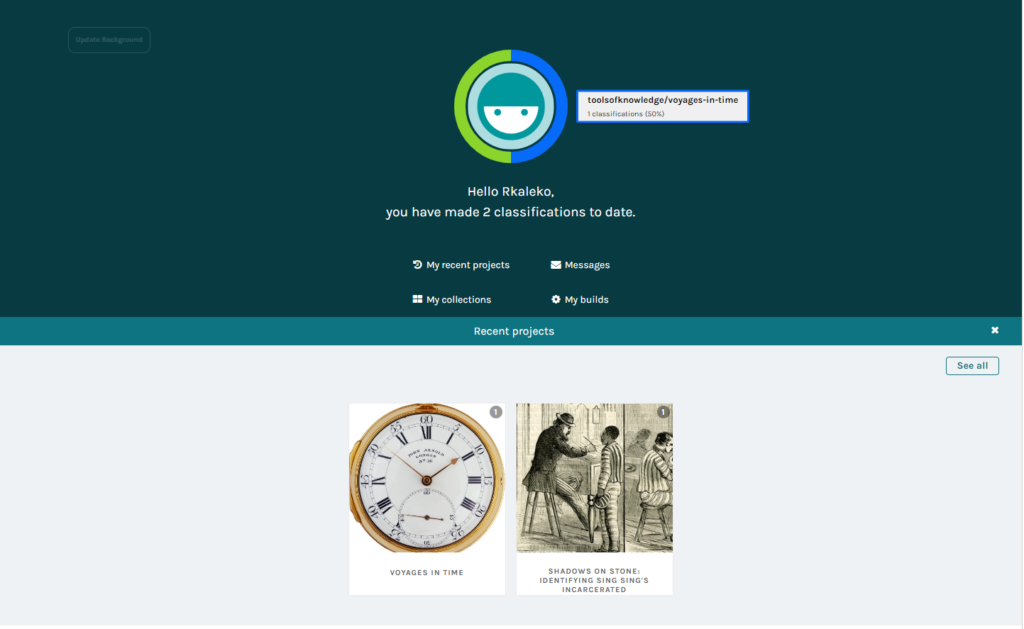
Over my Thanksgiving Break, I decided to check out the many projects available on Zooniverse and try to help out with some of them. While I took part in two different transcription projects, the one most related to a museum was Voyages in Time, which is part of the Tools of Knowledge project put together by University of Cambridge, University of Sussex and National Museums Scotland. This project aims to assemble a large volume of diverse data to which it will apply cutting-edge methods of digital analysis. The research is grounded in the existing Scientific Instrument Makers, Observations and Notes (SIMON) dataset, comprising more than 10,000 records on individual instrument makers and firms from Great Britain and Ireland. To this is being added data from existing legacy databases, collections catalogues and new metallurgical research, as well as material newly extracted from historical texts or generated using advanced digital methods. The portion being crowdsourced on Zooniverse is a transcription of the Chronometer Ledgers of the Royal Navy from 1821 onwards for nearly 2 centuries. The portion of the ledgers being transcribed was the moments the chronometers changed hands, comprised of a name and a date. While a fairly simple transcription process, it was not without it’s challenges and importance.
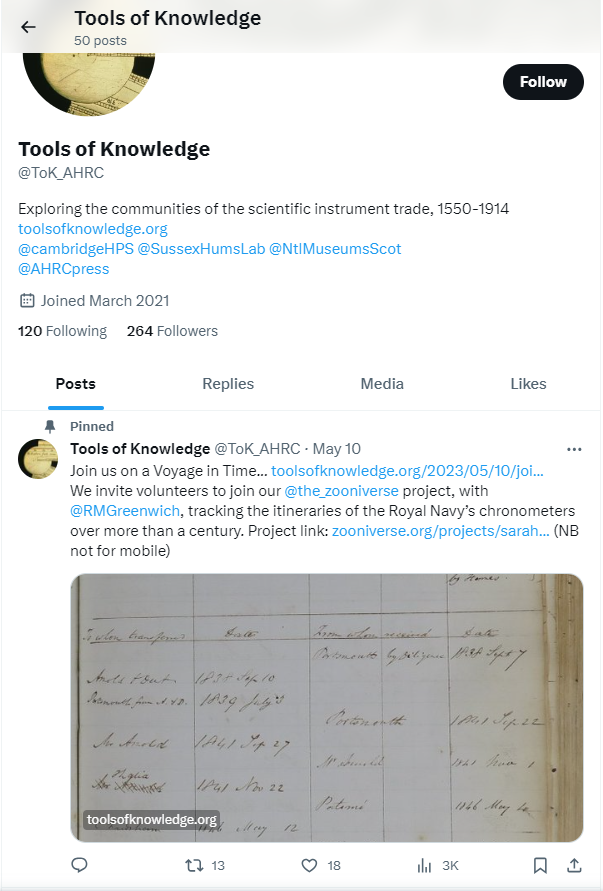
The Tools of Knowledge project utilizes multiple platforms to showcase their research, and utilize them to help solicit participation for the crowdsourcing campaign. The research team has a website that includes a blog, a tab for events that may be filled at some point, and lots of other information. They did create blog posts for Voyages in Time, but unfortunately you, at this point, have to go digging to find them. This is not very effective advertisement, but their use of social media is much better. They utilize X (formerly Twitter) to discuss the entire project, but have pinned a post about Voyages in Time to the top of their page, and made the whole page public, not requiring people to log in or follow them to view their social media posts. This will allow a larger variety of people to see the crowdsourcing project, as X is very popular, especially among the young professional generation. The project is given a catchy and exciting name, and they do their best to make what is ultimately a fairly uninteresting topic to most sound important and exciting. I feel these devices of fostering engagement will be most effective with college students and other young professionals with an interest in research, especially those with a love of history. The naming and social media use will attract those populations, though a very useful population, older – especially retired – adults, is not catered to. They are much more likely to use Facebook, and the project did not seem to have one. The requirement of reading cursive writing, which I will discuss later on, makes this population invaluable.
The Challenges of Transcription
I don’t think anyone would be surprised to hear that transcribing a handwritten ledger from the late 1800s and early 1900s, written by a wide variety of hands, would be a little difficult and ambiguous. The ledger contained a number of different styles of cursive writing, which in of itself is not something most people my age are used to reading. I will not shy away from admitting that I made use of my fiancé’s aunt, who taught 3rd grade English for many years back when cursive was compulsory in that grade level. She was very helpful in helping me to come up with the correct words. Still, I am not sure of some of our words, particularly one name we transcribed in multiple places at “Pyatt”. Still, the research team attempted to help prevent this issue by offering up databases of ship and captain names from the period, as well as a digital collection from their partner museum which contained chronometers and their manufacturers. They also made it possible to use the “unclear” tag when you weren’t sure of what you were writing.
Mitigating Risk
Using crowdsourcing in transcription is inherently risky, as there is no way to be sure that these untrained volunteers will provide accurate transcriptions. The team behind Voyages in time attempts to mitigate this in a number of ways. The first is the use of the platform of Zooniverse. Easy to use and user-friendly, as well as allowing researchers to provide guides and help, the platform is key for crowdsourcing projects of this kind. It also requires account creation, which requires an extra step to keep the more lazy of trolls from taking part. The most important tool Zooniverse offers, however, is the fact that multiple users will all transcribe the same page. This gives the researchers a body of transcriptions to look at and choose the one(s) that are correct. While I feel this step is necessary, I also feel it defeats the purpose of the crowdsourcing to some degree, as it still requires a researcher to look at the source and choose a transcription. This feels like they are almost doing the transcribing themselves, but I assume it does make it at least a little easier.
The Big Picture
Let’s face it, its not a huge number of people who are going to be interested in taking part in crowdsourced transcription projects as a use of their very limited free time. If not for this assignment, I would have probably never even known Zooniverse existed. Herein lies the issue museums will have with crowdsourcing in the future, and surely already have in the past. Even with social media, getting the message out to interested parties is so difficult in an age where we are bombarded with information from all angles. Voyages in Time was advertised on a single social media platform, and not in a way it would be forced into people’s faces. While museums may be able to advertise their initiatives in person or on their website, finding able, willing volunteers for these huge projects is difficult. Voyages in time currently has 290 volunteers, and thousands of pages to transcribe. If the work has no rush, then sure, go ahead and post it on Zooniverse, but more urgent projects simply won’t get done in time.
There are certainly benefits to this process however. Success stories for transcription projects are plentiful, such as the Australian Newspaper initiative from the National Library of Australia where in a year “…over 6000 members of the public had already enhanced the data significantly by correcting over 7 million lines of text in 320,000 articles, and adding 200,000 tags and 4,600 comments to articles” There is also great hope and examples of success for knowledge sharing to help with other needs of museums, such as conceptualization, collection improvement and development, and classification. Though the system is not without it’s challenges, it has been proven to work and help museums to complete tasks they just don’t have the manpower to do themselves.
While the approach that has been used is proven to work, in the case of Voyages in Time, at the very least, flaws have been seen and noted above. Museums must be careful to make sure they reach out to audiences with large amounts of free time like the elderly, no easy feat in the digital age with the lack of knowledge of most of that population. I would suggest that instead of trying to use the digital sphere to revolutionize the process of reaching out for crowdsourcing, museums in this one space just stick to the good old fashioned way of doing things, grassroots and in person engagement to get their communities aware of these opportunities. Earlier I spoke about my fiancé’s aunt helping me with the transcription process. She said that she was certainly going to spend some time doing some transcriptions of her own, but she would never have found out about this service if not for me and this project. I’m just glad I was able, through word of mouth, to bring one more helping hand to a project who needed it.
Bibliography:
Oomen, J., & Aroyo, L. (2011, June). Crowdsourcing in the cultural heritage domain: opportunities and challenges. In Proceedings of the 5th International Conference on Communities and Technologies (pp. 138-149).

Leave a Reply
You must be logged in to post a comment.