This assignment was the perfect excuse to do something I’ve meant to do for a long time: Begin transcribing documents for the National Archives. The Citizen Archivist program allows interested members of the public to help make digital documents searchable by transcribing their contents. My personal work experience lies in university and public library assistantship, and I am trying to get volunteer experience in archives and digital initiatives. I believe this is a good start!
I found this program a few months ago by searching for digital archives volunteer experience. The National Archives addressed how they engage citizens in this blog, which says they posted the opportunity on Twitter on Dr. Martin Luther King, Jr. day. That time, they advertised the opportunity to transcribe and tag slave ship manifests. NARA garners citizen engagement by posting opportunities on social media to engage in transcription relating to specific topics like this. I assume that most people who follow the National Archives and actually engage in citizen archivist efforts are those interested in library science, museum and archives, history, government, or specific social justice topics.
For this assignment, I started transcribing a document I found previously for my Government Information class. It’s the entire case file for Readers Subscription, Inc. v. Robert K. Christenberry. Going forward, I will focus on shorter documents to transcribe at first, as this one is 600 pages. There was a stamp on the page that I initially wasn’t sure how to handle. I found instructions for transcribing stamps on the citizen archivist transcription tips page. I made a judgment call on which order to transcribe the stamp and other information that was on the right side of the page. I ended up placing them after the address, case title, and court information on the left side of the stamp, as it made sense to put that information consecutively.
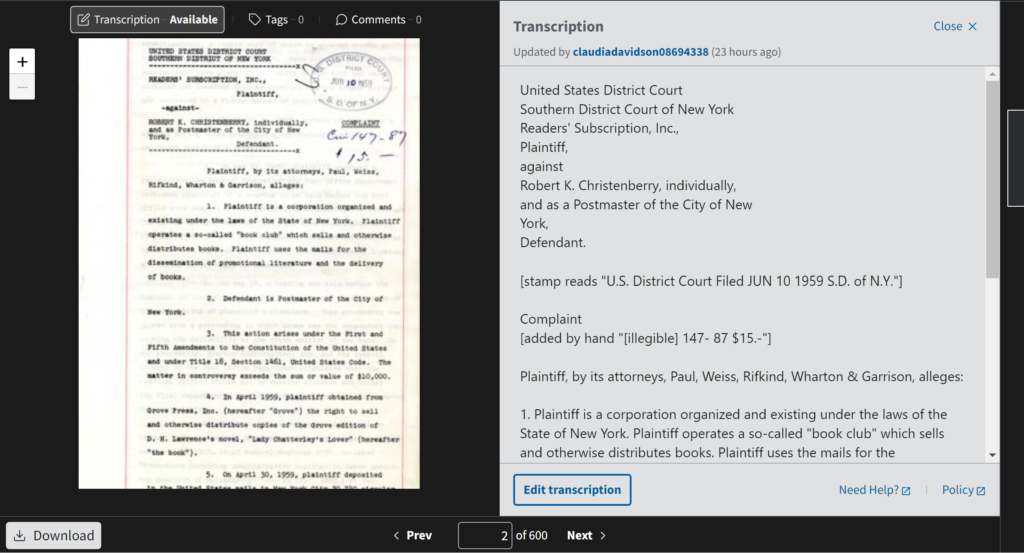
The sign-up process was easy and I did not have to go through any kind of test or practice run. It only asked me to agree to terms and conditions and make an account. All of my transcriptions will be linked to my account. There was an option to look over transcription tips and instructions before beginning, but they did not make it necessary— though it wasn’t obvious how to begin transcribing until I looked at the documents. I was surprised that there wasn’t a mandatory training video and quiz to take before beginning, and I wonder how risk is mitigated there. It’s possible that the benefit just outweighs the risk. The National Archives’ collection is vast and, according to the previously mentioned blog post, they have a relatively small staff.
One major challenge I see for museums engaging citizens in information creation is a lack of consistent format. An information system should make their controlled vocabulary clear and easily accessible before citizens begin tagging. The same can be said about common formatting patterns for transcriptions. A lack of consistent form, especially with tagging, can create difficulties with information retrieval. The benefits to crowdsourcing are significant. Many museums and other information systems are understaffed. Even when they aren’t understaffed, there are other daily tasks to deal with. When an institution has a vast collection, the task of digitizing and all that comes with it can be overwhelming. Volunteers like us can take some of this weight away, and it also gives us experience and a sense of contribution to history. It would be a good idea for museum staff to reach out to undergraduate and graduate programs in related fields to recruit more participation. This is bound to recruit eager volunteers who previously did not know about the opportunity.

Leave a Reply
You must be logged in to post a comment.