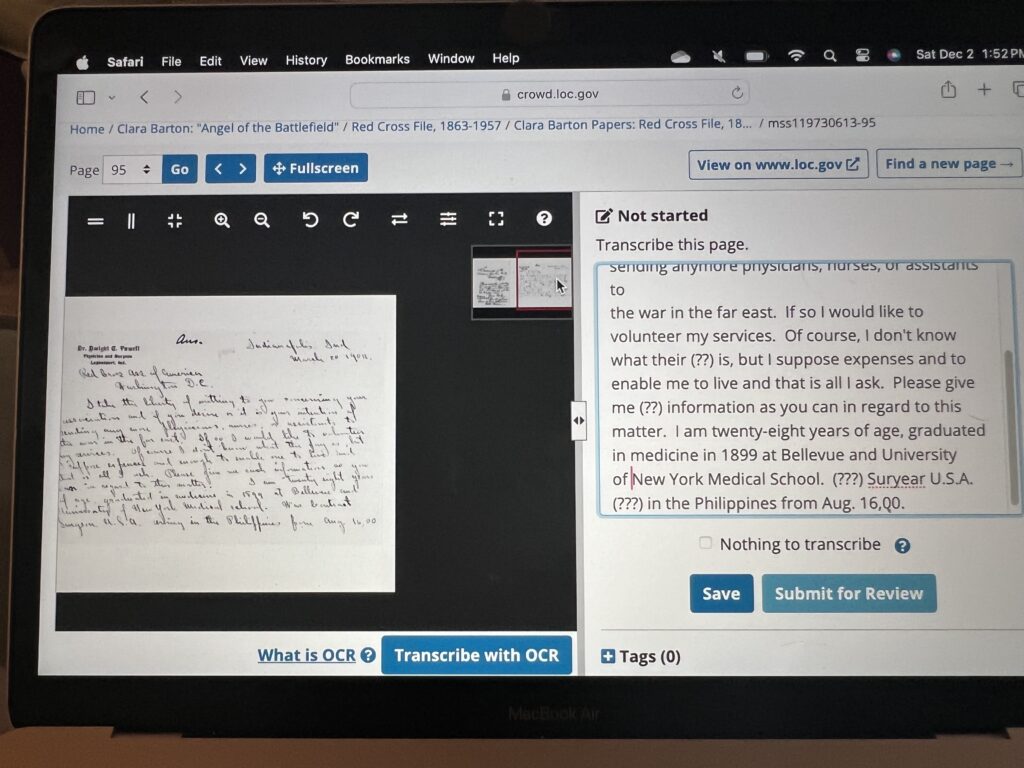
I chose to participate in crowdsourcing through the Library of Congress (LOC)
“By the People” campaign. My contribution was to the Clara Barton: “Angel
of the Battlefield” campaign transcribing letters, papers, documents, and news
reports of her time and activities. This campaign is accessed via
www.crowd.loc.gov. The website is very detailed and offers information about the
campaign, campaign topics, resources, a discussion section for volunteer
questions and answers, and a “How-To” section.
This crowdsourcing campaign invites volunteers to review and transcribe
digitized pages from the collections of the Library of Congress. The project is
open to anyone interested in the activity and began in the Fall of 2018. As of
11/2023, 987,000 pages have been transcribed across 39 campaigns. According
to the website, the name “By the People” was chosen in honor of Abraham
Lincoln’s Gettysburg Address as a reflection of democracy and government by the
people.
Volunteers are asked to transcribe and review digitized pages in various
categories from the Library’s collections. Examples of collections/campaigns
include “Correspondence of Theodore Roosevelt,” Sheet Music of the Musical
Theater,” “Walt Whitman,” and “American Creativity: Early Copyright Title Pages,”
etc.
The LOC relies on various avenues to solicit input from the public. The first way
is by using the website. The website is very well positioned and is clear and
helpful in assisting volunteers with instructions on how to contribute and
answering any questions. Secondly, the LOC uses a blog site to keep the public
informed of the status of on-going campaigns, new campaigns, and information
about the crowdsourcing project. The LOC also contributes information about its
crowdsourcing to professional journals and publications to keep the public
informed about the projects and solicit participation. Finally, the LOC maintains
active press coverage to solicit public participation. For example, the July 31,
2019, Smithsonian Magazine published an article entitle, “The Library of Congress
Needs Your Help Transcribing Suffragist Papers.”
A common crowd-sourcing rhetorical strategy of the LOC is the appeal to
publics’ emotion. From 2019 to 2023, the LOC is mentioned in eleven press
articles. In five of those articles, the title of the articles includes the phrase “needs
your help.” One interesting rhetorical strategy is an appeal to logic in a press
article announcing the National Archives has billions of handwritten
documents in cursive writing, but asks how we will read them with the decline in
cursive handwriting ability? Another appeals to natural curiosity with an article in
the Washington Post about Lincoln’s mail including advice and a call to shoot
deserters. Immediately I was curious as to the contents of Lincoln’s mail and
questioned the identity of the deserters and the desire to have them shot.
The various strategies used by LOC appeal to a wide audience. People
interested in government will naturally be interested in the LOC crowdsourcing
project. People interested in particular campaigns might desire to contribute to
only one campaign. People interested in preserving important national documents
will be interested in “By the People.”
I noticed one area of ambiguity in contributing to this campaign. The
instructions state it is unnecessary to create an account to contribute to the
crowdsourcing campaign. However, I could not determine how to contribute
without an account, because every time I attempted to submit my contribution, the
site requested that I log on to my account. Therefore, in order to complete the
assignment, I created an account and was able to submit my contribution.
I did not experience the need to make judgment calls in my transcription of the
document. I found that the words were either decipherable or completely
undecipherable. The instructions noted the transcriber does not need to be
concerned, because another contributor will follow your transcription and may be
able to decipher words you could not transcribe. The campaign instructs you to
transcribe what you can realistically complete.
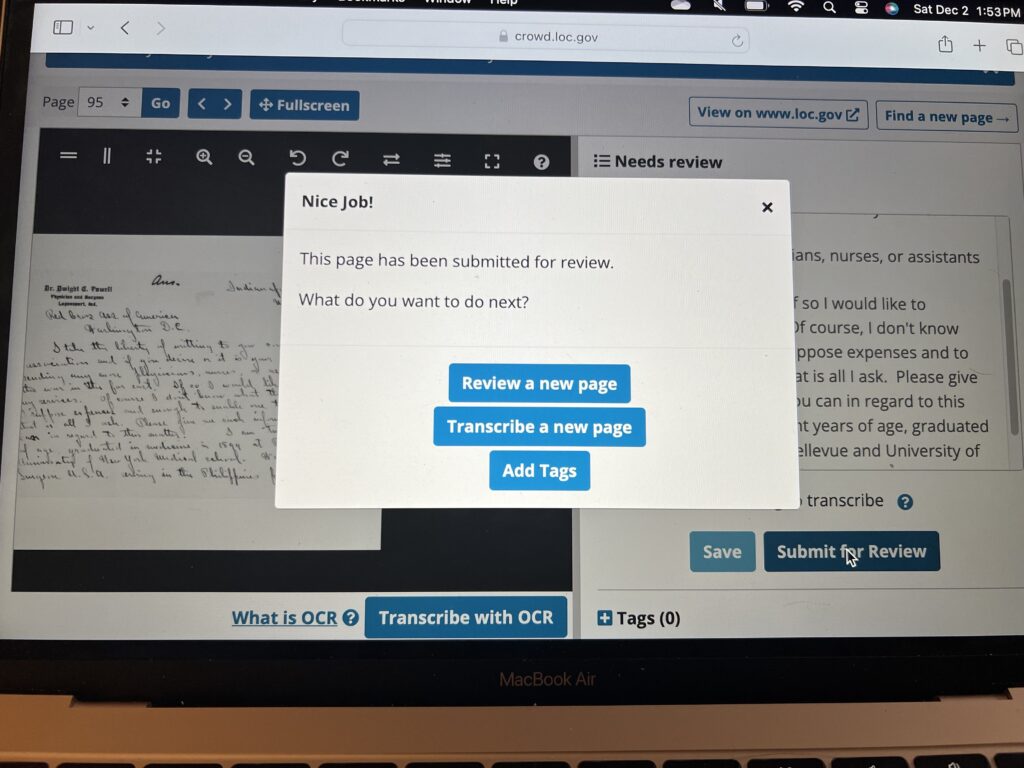
The LOC mitigates risk with this project by asking you to submit the item
transcribed for review. After logging in and completing my transcription, it was
sent to reviewers to complete a series of steps. A reviewer is assigned to check
your transcription. The reviewer reads the entire transcription and compares it to
the image of the document. Reviewers are also volunteers, but they are required
to register with the site. The reviewer can approve the transcription or make edits
or request other volunteer reviewers make edits. However, transcribers cannot
review transcriptions they have completed. When the page is determined
to be accurate, the reviewer accepts the transcription. It is then ready to be
published in the Library of Congress. At this point, my transcription is still under
review.
The only “term of service” I noted was to provide a valid email address. As
stated, the website says people can contribute without registering, but I did not
find this to be accurate. Therefore, I registered. After registering and providing a
valid email address, the site sent me a verification email to verify my email
address. I clicked on the verification email and was registered.
The Library of Congress functions as a library and a museum. It contains
books, photographs, and numerous exhibits. Presently, the LOC offers seven
exhibits in its various galleries. Present exhibits include political cartoons,
animation art, and comics, various maps of the world, and the music of the George
and Ira Gershwin. I found engaging with the LOC’s crowdsourcing project
entertaining and very interesting. The site is very clear and helpful in assisting
volunteers with contributions.
Museums and cultural institutions face challenges regarding crowdsourcing.
They must find ways to engage the public and entice them to contribute,
particularly to topics/images that only few may find interesting. Secondly, people
will likely contribute to crowdsourcing regarding topics with which they are familiar
or knowledgeable. Finding or attracting these people may be difficult.
Crowdsourcing must be accurate. I noted that initial transcriptions are created by
volunteers at the LOC, and volunteers review the transcriptions. I did not see
where professionals with knowledge of the topic reviewed the contributions for
accuracy. It is important that crowdsourcing is accurate, particularly at an
institution such as the LOC. The LCO is our nation’s library and museum. It is
used for general educational and scholarly purposes. What happens if the
information is inaccurate? Finally, a robust crowdsourcing endeavor requires a
budget for IT professionals and librarians to oversee the activity. While the LOC
can access these necessities as a government agency, smaller museums and
privately funded museums may have difficulty hiring staff or staff with the requisite
expertise to successfully implement a crowdsourcing project.
Regardless of the challenges of crowdsourcing, the benefits are substantial.
Work can be completed by volunteers for institutions without the means to hire
professional staff. People with knowledge of a topic may be compelled to add
their expertise for free. Crowdsourcing helps to increase public interest in an
institution and hopefully increase traffic and/or donations in the museum. Also,
crowdsourcing increases general public awareness of museums via articles and an
online presence.
Museums and cultural institutions will need to find a way to offer crowdsourcing
as a volunteer activity. With the advent of internet use, access of museum exhibits
via internet, and restrictive budgets in museums, crowdsourcing is a natural
progression to publicize offerings to the public and increase museum attendance.

Leave a Reply
You must be logged in to post a comment.