The Citizen Archivist project is an initiative of the National Archives in which members of the public are invited to provide tags and transcriptions of various archival documents and records. The project encourages individuals to interact with cultural heritage and contribute directly to the archival process, while also making the work of the archivists much more efficient. The rhetorical strategies used to solicit participation are relatively minimal, focused on straightforward messaging about contributing to the future of fully digitized, accessible archives. While anyone is free to make an account and participate in Citizen Archivist, this minimal advertising indicates that the platform will be mostly visited by, and of interest to, individuals who already have some form of investment, whether personal, academic, or professional, in cultural archives and records.
I contributed to two collections in Citizen Archivist by providing transcriptions of scanned documents. The first was a UFO file in the Roswell Report Resource Files, and the second was an Interrogation Report of Nazi war crimes from the CIA. It was a fascinating experience to interact so closely with these documents and see two very different aspects of this time in history. Both of the documents were typewritten, so I did not have to decipher difficult handwriting, although in many places the ink was very faded or the type had not printed clearly, leading to ambiguity regarding many words and letters. In these cases, I tried to distinguish letters by comparing them to their more clearly typed counterparts and using the context of the sentence to evaluate them. Another challenge I encountered was that the Interrogation Report was written entirely in German. I have some familiarity with the German language but I am by no means fluent, so this was an opportunity to revisit my knowledge of the language and utilize these skills to resolve issues of ambiguity.
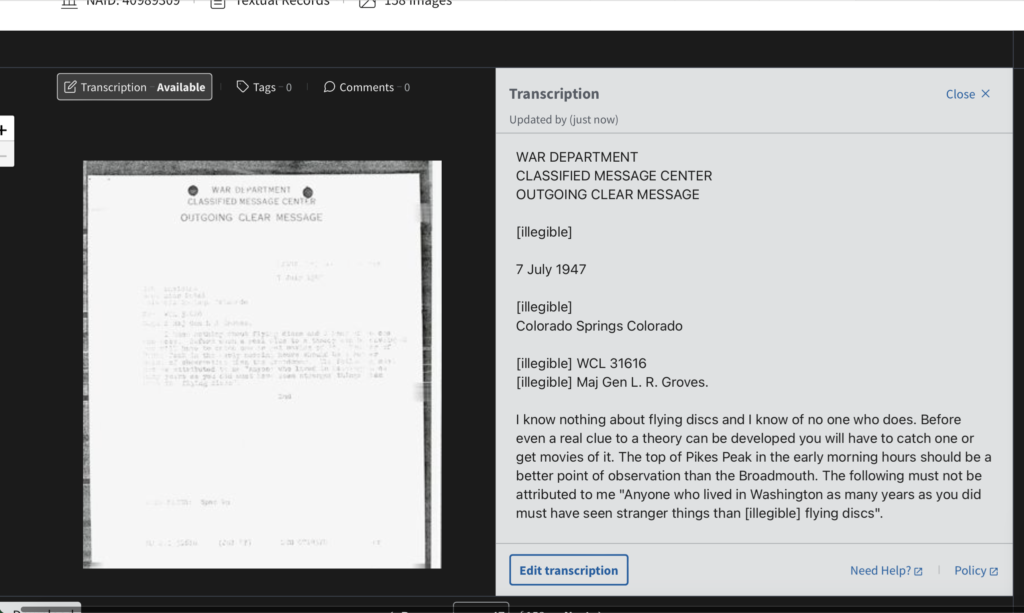
https://catalog.archives.gov/id/40989309?objectPage=47
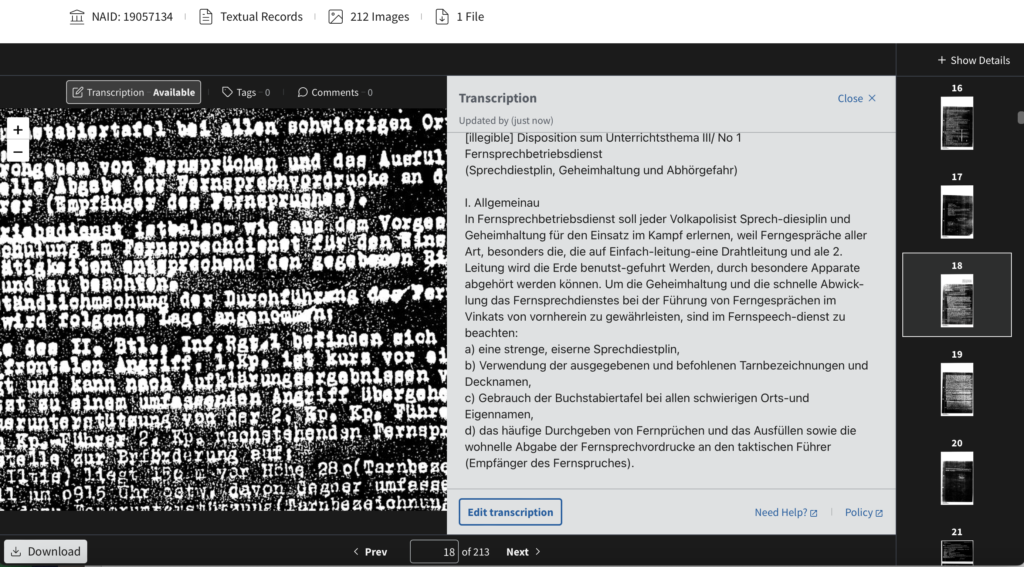
https://catalog.archives.gov/id/19057134?objectPage=18
As mentioned earlier, two major benefits of crowdsourcing for the creation of cultural knowledge are the increased involvement of the public and the easing of labor for archival/museum professionals. Allowing the public to participate directly in these processes broadens their connection to their cultural institutions and ensures that these resources function for the benefit of the public. Additionally, involving the public in these projects allows professionals to utilize more of their expertise by moving quickly to tasks requiring more specialized knowledge. On the other hand, possible issues with crowdsourcing include inaccurate responses, as well as the ethical consideration of the participants’ unpaid labor. For museums and archives to minimize these risks while increasing community engagement, they will need to install measures to verify the responses of contributors as well as guarantee that all crowdsourced resources remain feely accessible. It is also important to broaden community awareness and reach wider audiences with these initiatives, ensuring that they will involve the public community as a whole, rather than remaining in already-involved academic circles.

Leave a Reply
You must be logged in to post a comment.