Link to Item 1 | Link to Item 2
For this assignment, I chose to register with the Citizen Archivist (CA) program run by the National Archives and Records Administration (NARA), which allows ordinary citizens to participate in the practice of cultural preservation by transcribing and tagging items in NARA’s vast collection. I wish I could say I had been able to discover this project on my own (particularly as someone with an interest in archival work), but I found it difficult to find a cultural heritage institution with an active crowdsourcing project; instead, I found the CA while browsing blog posts on this site. There are a few reasons why I think I struggled to find anything on my own–I’m not active on social media sites like Twitter/X or other more library-specific forums, both of which might be used to spread information about crowdsourcing initiatives. Using search engines proved difficult as well as I had trouble figuring out which search terms would produce good results.
After participating in Citizen Archivist, I decided I would look around NARA’s social media profiles to see how they were trying to generate interest in the program. As it turns out, mentions of CA were few and far between, the most recent reference to the program on Twitter was posted more than a year ago. This surprised me, considering that 1) NARA recently overhauled their digital catalog and 2) public interest in archives is likely higher than usual following the declassification of most of the records surrounding the assassination of John F. Kennedy. Now seems like an excellent opportunity to be soliciting help from the public and generating further interest in cultural preservation.
Contributing to the Archives
NARA provide participants in the Citizen Archivist program with plenty of resources to make sure they provide quality contributions. The resources page describes best practices for transcription and tagging, cheat sheets for common abbreviations and archaic spellings, and many, many examples of the kinds of documents one might encounter in the catalog. I found myself referring back to these pages frequently if I came across anything I wasn’t sure about. The CA dashboard highlights a number of missions–specific collections that NARA is focused on getting transcribed and tagged. (One such mission is the aforementioned JFK Assassination Records Collection.) Below the missions, NARA features individual records that need transcribing as well, sorted by difficulty; I chose one of the beginner-level items and got to work.
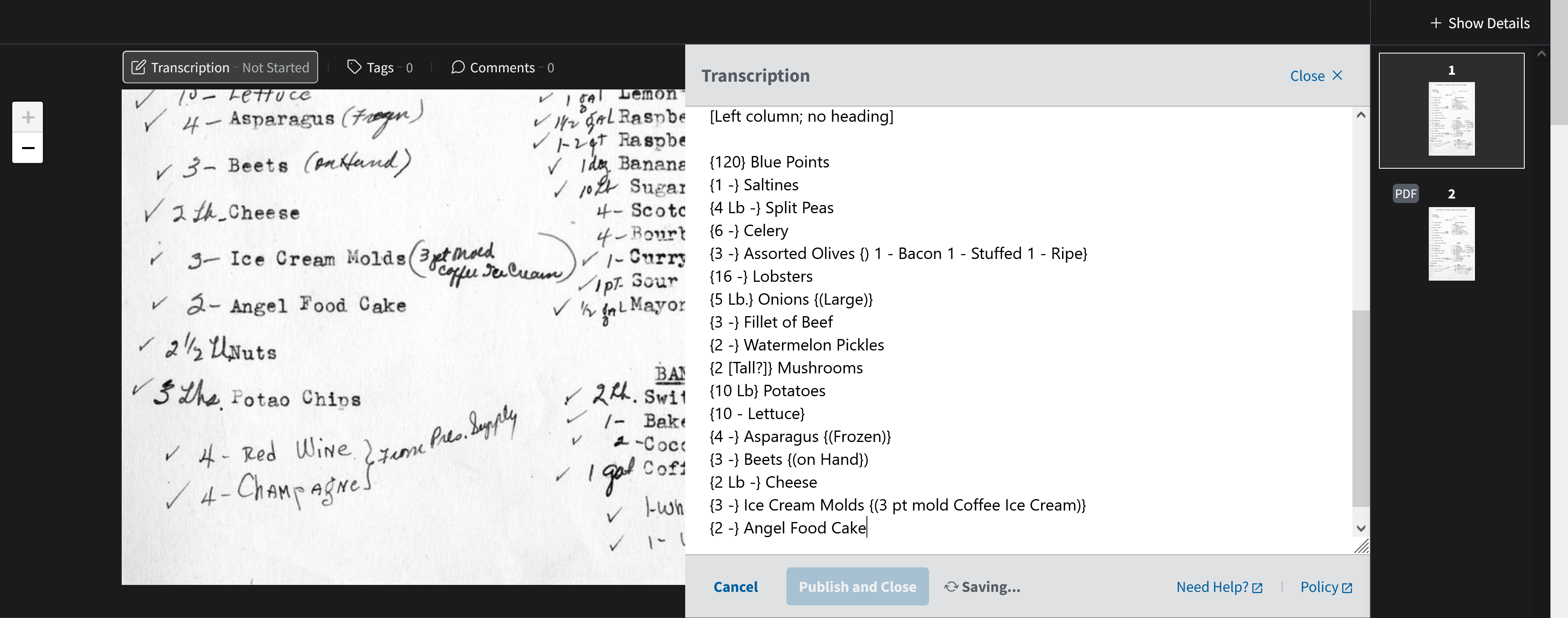
This shopping list for a White House dinner may have been easy to read, but formatting the transcription was a lot trickier. When read, the document frequently switches between handwriting and printed text; tems for the dinner were typed, but their quantities were written in the margins. NARA asks that archivists prioritize readability when formatting transcriptions, so using phrases like “[handwriting]/[end handwriting]” like in example documents would have created too much clutter. I decided to use curly brackets to indicate handwritten text and added a note at the top of the transcription to explain their use. I also needed to add a separate note to indicate checks next to most items on the list.
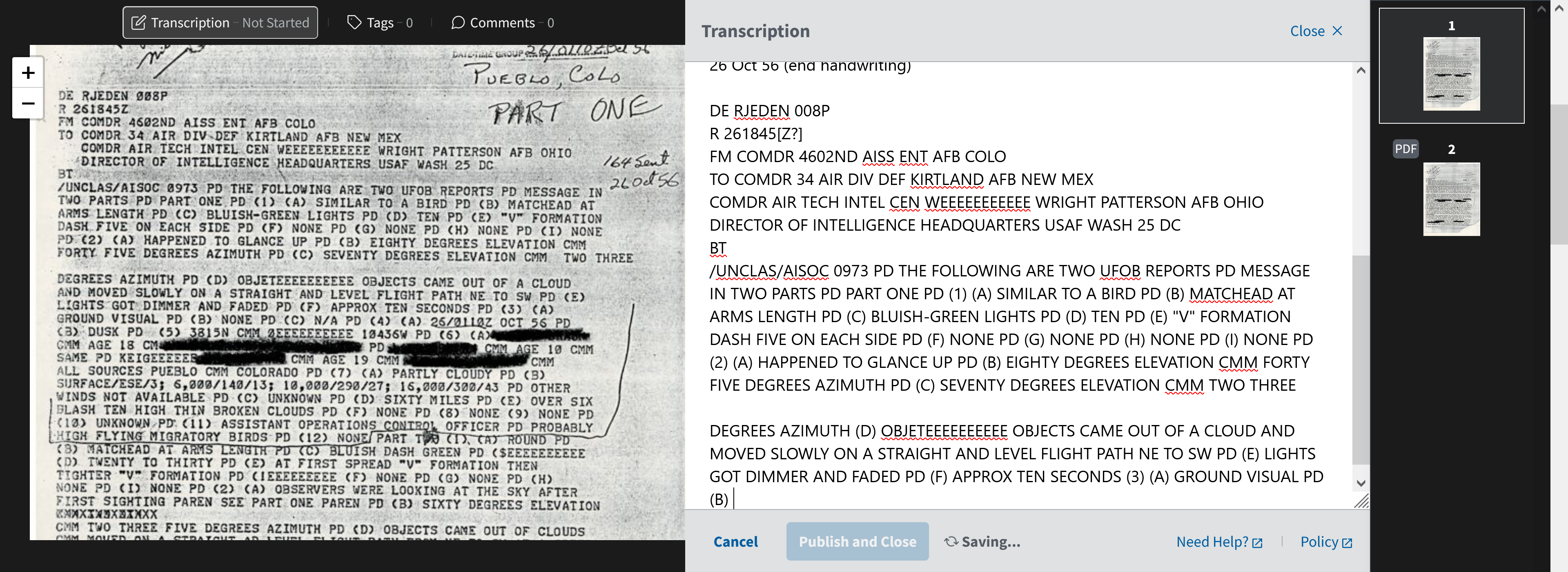
Another transcription worth highlighting concerns a piece of correspondence belonging to NARA’s collection on UFOs. Above all else, best practices tell citizen archivists to “type what you see,” guidance that proved frustrating while trying to transcribe this document. Below are some of the challenges I faced:
- The typed portion of the document is written in all caps. Using mixed case would have improved the readability of the transcription, but I didn’t want to make judgement calls on capitalization.
- Punctuation is almost entirely absent; terms like “PD,” “CMM,” and “PAREN” are used to indicate periods, commas, and parentheses respectively. These terms take up a significant portion of the document.
- Mistakes committed by whoever typed the document needed to be preserved; these were usually indicated with a long string of E’s before the message continued.
Like with the shopping list, reading what was written wasn’t terribly difficult, it was creating an accurate an effective transcription that gave me a greater challenge. It definitely helped that I stuck to documents from the 20th century; I didn’t feel confident enough to tackle older handwriting, which I struggled with reading during an archives course I took as an undergrad.
Crowdsourcing Cultural Preservation
I really enjoyed my experience with the Citizen Archivist project and hope to continue adding transcriptions when I have the time to do so. Both the NARA and the general public benefit from crowdsourcing the frequently-tedious processes of transcription and tagging. It frees up resources that the organization can then allocate to other initiatives, and it improves the readability and searchability of its massive collection. Users who contribute via CA also benefit from a more accessible collection and (perhaps more relevant to an emerging professional like myself) gain experience doing things I may not previously have found the opportunity to do. I also get the impression that the voluntary nature of CA ensures that contributors are enthusiastic about the work they’re doing, which could improve the quality of transcriptions and tags.
I do think that there are potential downsides to crowdsourcing this kind of work, especially on this scale. Every contributor is going to have a different approach to transcription, different opinions on what tags are relevant to a given document, and different quirks in their writing. How do you remedy those differences? I think NARA is doing what they can with its extensive Resources page to achieve a certain level of consistency and quality, but I would love to know more about the review process for CA transcriptions and tags. To me, there is a balance between removing restrictions to let users contribute open-ended contributions and exercising (quality) control to make sure those contributions are worthwhile. It felt like NARA has struck that balance with the Citizen Archivist program.

Leave a Reply
You must be logged in to post a comment.