- How does this cultural heritage institution solicit participation from the public? What rhetorical strategies is the institution using to garner engagement? What audiences do you think these strategies would be most effective with?
The Library of Congress has an initiative called By the People where they ask visitors to “be a virtual volunteer!” and help transcribe and/or review transcriptions of items in their collection. They make the barrier of entry as easy as possible by not requiring volunteers to make an account. For volunteers that want to take the extra step of reviewing transcribed materials, an account is required. The home page uses several different ways to encourage engagement. They have curated collections for volunteers to choose from they call campaigns. These collections are organized by topic, for example “My great mass of papers”: Correspondence of Theodore Roosevelt and Clara Barton: “Angel of the Battlefield.” Calling the archival collections campaigns gives volunteers a more active role in the digitization project. Volunteers are not just doing menial metadata creation, they are working towards a goal that will have tangible benefits to the world. The descriptions of each campaign also are used to urge participation. For example, in the Theodore Roosevelt campaign description, it is noted that this transcription project was born out of the pandemic and Library of Congress employees needed digital projects to work on when offices were closed. The end of the description reads: “Now it’s your turn! Can you help transcribe the remaining project from this ‘great mass of papers’?” Campaigns are organized operations where many people work towards a common goal, what better way to make transcribing more exciting by connecting it to the bigger picture and overall goal?
Additionally, underneath each of the project descriptions is a completion bar that shows how much of the project has been transcribed and how much review of transcriptions is needed. Showing how much of the project is completed gives people a sense of satisfaction as they can be apart of moving that bar along. I was influenced by this as I chose to help transcribe a collection that is only 7% completed, “Sheet Music of the Musical Theater.” I wanted to help a campaign with the lowest completion rate. I think this strategy would work best on people who thrive off instant gratification and people who want to feel like they are apart of something bigger than themselves. This is reinforced on the site as the completed campaigns are also listed alongside the exact date of completion. I believe that more people would be willing to complete transcriptions when they know they will be able to influence the completion percentage and completion date.
- Was there any ambiguity in the information you provided? What judgment calls did you need to make when providing the information? Examples might be uncertainty about a given word you transcribed from a hand-written letter or some ambiguity for which label to provide for an object.
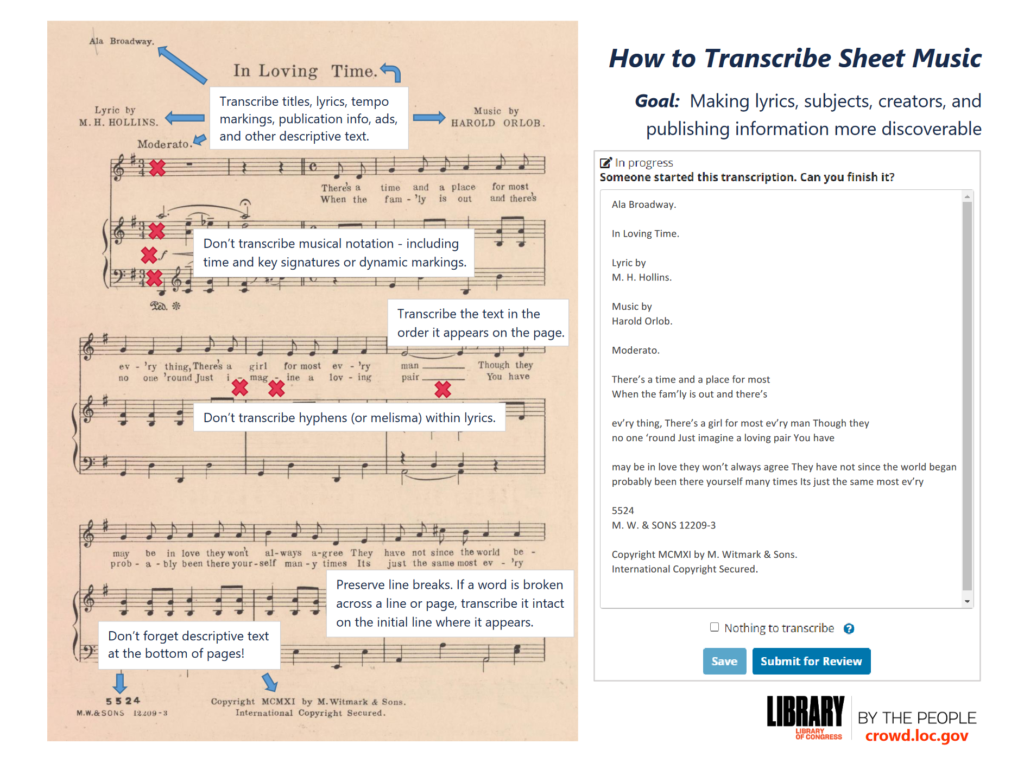
As mentioned previously, I decided to help transcribe items from the “Sheet Music of the Musical Theater” campaign. I chose this collection because it has the lowest completion rate out of the active campaigns and I wanted to transcribe a non-traditional document to see how the Library of Congress transcription instructions hold up to these documents. There are separate instructions for how to transcribe sheet music, as shown here. These separate instructions tell volunteers to transcribe all words on the page, not just the lyrics to the piece and to exclude any musical notations. These instructions helped a lot with the first piece I transcribed that was just a page with sheet music. I had no trouble transcribing this page because it conformed to the instructions quite well. After completing this page I clicked “Find a new page” and was to the following “Monthly Bulletin of New Music.” This is where I started having trouble. Just as it sounds, this page lists a couple dozen new pieces of sheet music that are available to purchase. The instructions I had the most problems with were the ones that said to preserve line breaks and not to transcribe hyphens within lyrics. In any other document, I would write the full text, separating paragraphs but not necessarily by line. Because of the Library of Congress instructions, I was not sure whether to start on a different line whenever the page started on a different line or type out the whole sentences. I decided to split the difference and write out entire sentences normally, but preserve a line break when it meant a word was hyphenated.
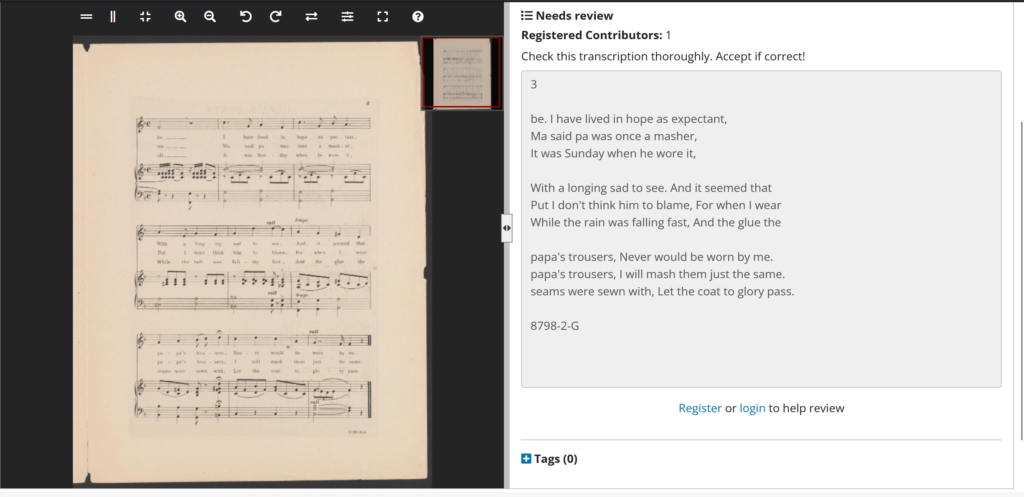
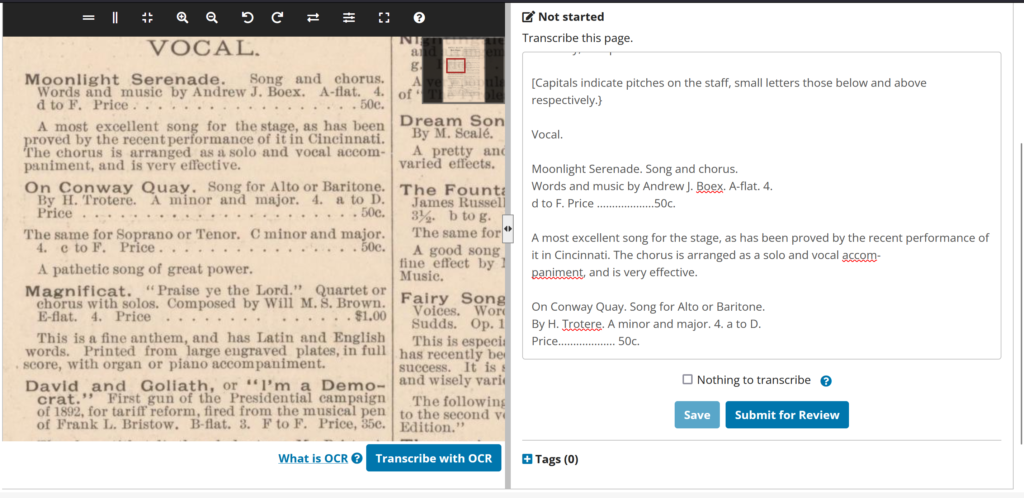
Another issue I had was deciding whether or not to include the periods after the description of each piece that were followed by the piece’s price. The instructions say to not include hyphens within lyrics, which led me to think that I should not include these periods. However, because of the instruction that asks volunteers to preserve line breaks I decided to just include the periods. I hope that whoever reviews these transcriptions has a better understanding of what the Library of Congress is looking for than I do.
- How did your institution mitigate risk related to this project? Were your contributions sent out for review? Did you have to log in to provide your contributions? Were there terms of service to provide information?
Compared to other transcription crowdsourcing projects I have researched, I believe the Library of Congress has done a significant amount to mitigate risk. I was impressed that they made separate instructions for the sheet music collection. Also, at the top of the home page of the site is a link to get started which points volunteers directly to instructions. The instructions are fairly comprehensive and even give volunteers options for how to transcribe words they cannot make out. Furthermore, requiring an account in order to review transcriptions is a barrier of entry that I believe would make sure only the more dedicated volunteers complete this step. There is also a discussion forum for reviewers to ask questions, a way to send staff messages, and a separate FAQ page. After searching through the forum, I found that Library of Congress staff also use the forum to ask for additional edits on transcriptions that have already been reviewed. I am impressed by the level of support volunteers and staff have completing these transcriptions. The website has a legal page, but I could not find any specific terms of service for transcribers.
- Address your experience engaging with crowdsourcing in the larger context of museums. What challenges do you see museums facing when it comes to engaging audiences in the creation of knowledge? What benefits do you see? Will museums have to change their approach to audience engagement to facilitate this type of participation?
I know there is far more to transcribe than museums could ever hire employees to complete, however the cynical side of me finds that these crowdsourcing projects are more ways in which cultural institutions take advantage of free labor in lieu of paying people. I wonder how many people were employed at the Library of Congress to transcribe documents and if anyone lost their jobs to this crowdsourcing program. As someone who has transcribed as an intern for free and as a student for free and as a paid employee, I can see how little metadata creation is valued despite it being so important to further research and create accessibility. Despite multiple risk mitigation tactics, I am sure there are still many errors that fall through the cracks in these projects. How much quality is lost when solely relying on volunteers? And how much quality is lost by solely relying on anonymous volunteers whose formal training amounts to reading a couple pages of FAQs on a website? I had to leave the museum profession because of the lack of jobs and the low pay in the positions I could find and now I am saddled with over $100,000 in student loan debt that I will most likely die with and have little to show for it. So to me, the increasing reliance on crowdsourcing over the internet seems more like a way to get out of paying people rather than a way to open up more documents for research purposes. Both things can be true at once however. There are massive benefits to having more collections online open for anyone to view. More people will be able to do research with less money.

Leave a Reply
You must be logged in to post a comment.