by: Vashti Jenkins Taylor
1. How does this cultural heritage institution solicit participation from the public? What rhetorical strategies is the institution using to garner engagement? What audiences do you think these strategies would be most effective with?
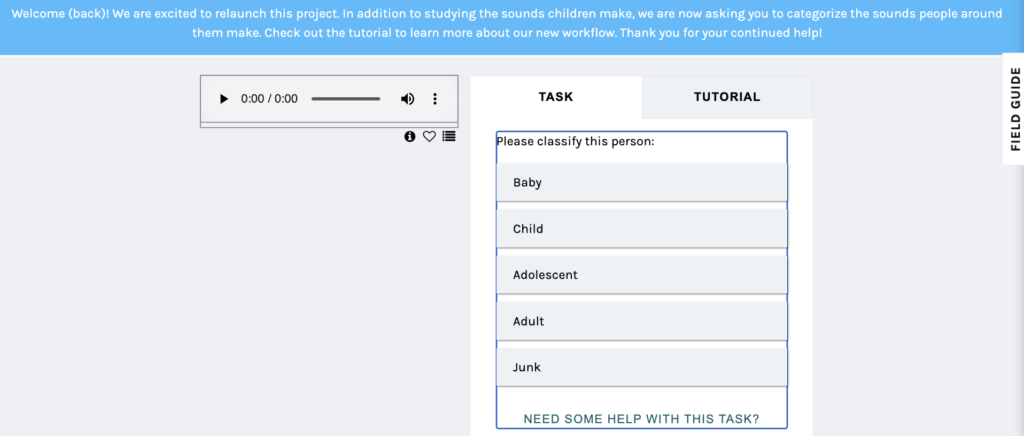
Image Above: Dashboard for the Maturity of Baby Sounds categorization. The dashboard shows an audio player to the right. On the left is the Classification question asking for the type of person. There is another tab further to the left for a tutorial and a tab on the far right of the screen for the Field Guide.
For this assignment, I participated on a crowdsourcing project on zooniverse for the first time. When researching for our Student Share assignment to find projects that recruited museum visitor knowledge, I came across mentions of zooniverse several times and ignored it. With its cute name, diverse projects and no immediately apparent affiliation with GLAM institutions, I initially assumed that it was not the actual host of any projects but must simply be reporting on them or aggregating a list of them. It wasn’t until I read the student share projects of my classmates that my assumption was corrected. Zooniverse is in fact a large platform hosting various crowdsourcing projects founded by the University of Oxford. The other institutions that help build and develop the platform like Adler Planetarium or University of Minnesota are also not featured prominently where new users would see them. I was able to find out more about the roles each institution plays in developing the site through the “Jobs in the Zooniverse.” This struck me as a strange choice because the seeming lack of familiarity was one of the main reasons I did not initially explore the zooniverse for myself. However, knowing these institutions were involved would have assured me of their credibility.
From what I could find, it is likely most users are not coming in cold to the zooniverse website but may be finding out about specific projects from news sources or from institutions with which they are already interested or involved . For example, the article “Search for Gravitational Waves With ‘Gravity Spy’ Citizen Science Project”, is posted in the STEM resources and opportunities section of NASA’s website and directly identifies educators and students as the audience for the post. I can imagine that many volunteers are students who have an interest in science or that have been assigned to volunteer by their instructors. If this is indeed how most volunteers are introduced to zooniverse then, I understand why it may not be as necessary to convince them they will be doing real work for real, trustworthy projects. However this may be limiting the amount of volunteers that could discover projects and the demographic of volunteers that participate.
The project I worked on, Maturity of Baby Sounds, is organized by Baby Lab, the Laboratoire de Sciences Cognitives et Psycholinguistique and the Max Planck Institute for Psycholinguistics. This information is most prominent on the landing page of the project where they are listed in the external project links. The main strategy to interest volunteers in the project is to explain the research objective of the project so that volunteers would know the use and value of their work. The “About the Maturity of Baby Sounds” section of the landing page describes what the latest version of the project is studying and explains how useful the data will be.
“…your responses will allow us to describe how babies’ speech development relates to the speech they hear, and compare different recording devices and even train machine learning algorithms. So a big thank you for your help!!!(About Maturity of Baby Sounds)”
The friendly tone and hopeful description will appeal to volunteers who share a curiosity about language and child development. Going through the talk pages, I suspect that most of the volunteers are adults based on the more analytical level of discussion that was taking place.
Zooniverse (n.d.) Jobs in the ZOONIVERSE https://jobs.zooniverse.org/
NASA. (n.d.) “Search for Gravitational Waves With ‘Gravity Spy’ Citizen Science Project”
2. Was there any ambiguity in the information you provided? What judgment calls did you need to make when providing the information? Examples might be uncertainty about a given word you transcribed from a hand-written letter or some ambiguity for which label to provide for an object.
The organizers of Maturity of Baby Sounds split the audio clips used in the project to protect the privacy of participants. Because the clips are only a few seconds long, it can be difficult to categorize a sound without the usual context. Volunteers are asked to categorize sounds by the possible age of the participant (baby,child, adolescent, adult), the type of sound (canonical, non-canonical, laughing, crying, junk) and by sex/gender in the older (adult and adolescent) categories. Canonical noises have clear syllables like consonants followed by vowels or vowels followed by consonants instead of less defined vocalizations. It can sometimes sound as though a sound might have been canonical but was cut off in the clip. It was also difficult for me to categorize age as I have not been around young children recently and felt unconfident deciding between infant and the lower end of the child category (3 years).
One sound was particularly interesting to me as it sounded like two voices, possibly two babies or someone making baby sounds along with the baby. I was able to leave a note on that categorization. Each sound allows you to either submit as “done” or “talk and done” where the second option starts a thread for conversation under the sound. I only ventured to use this option the one time although when I did, I regretted not using it to note the many other storage or ambiguous sounds I had encountered. So, I feel as though there is also a judgment call to start a “talk” note as well.
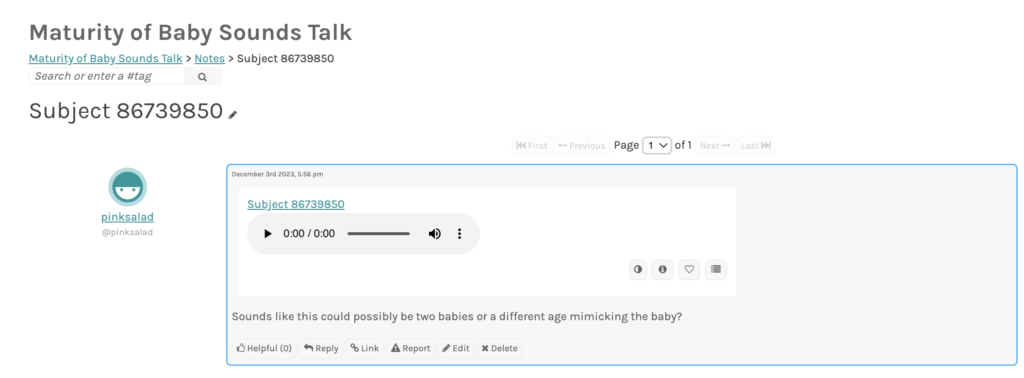
Image Above: A screenshot of the note I left on a baby noise audio file reading : sounds like this could possibly be two babies or a different age mimicking the baby?
3. How did your institution mitigate risk related to this project? Were your contributions sent out for review? Did you have to log in to provide your contributions? Were there terms of service to provide information?
In one of the “talk” threads of the project, I learned that 3 volunteers review each sound (laaczooniverse). I was not required to log in to participate, and I tried volunteering both anonymously and logged in. The difference was that there was a small prompt “You should log which” had a slight wiggling animation to bring attention to the message. I was also unable to participate in the “talk” and there was no way to track how many categorizations I had completed. There is a privacy policy for users that sign up to the site and they must agree to those terms, but otherwise, I do not think there were other conditions for joining a project.
thttps://www.zooniverse.org/projects/laac-lscp/maturity-of-baby-sounds/talk/3116/2676969
Laaczoonivers (2022, November 9) “ Feedback: Time-consuming” [Talk thread in Maturity of Baby Sounds]. Zooniverse.
4. Address your experience engaging with crowdsourcing in the larger context of museums. What challenges do you see museums facing when it comes to engaging audiences in the creation of knowledge? What benefits do you see? Will museums have to change their approach to audience engagement to facilitate this type of participation?
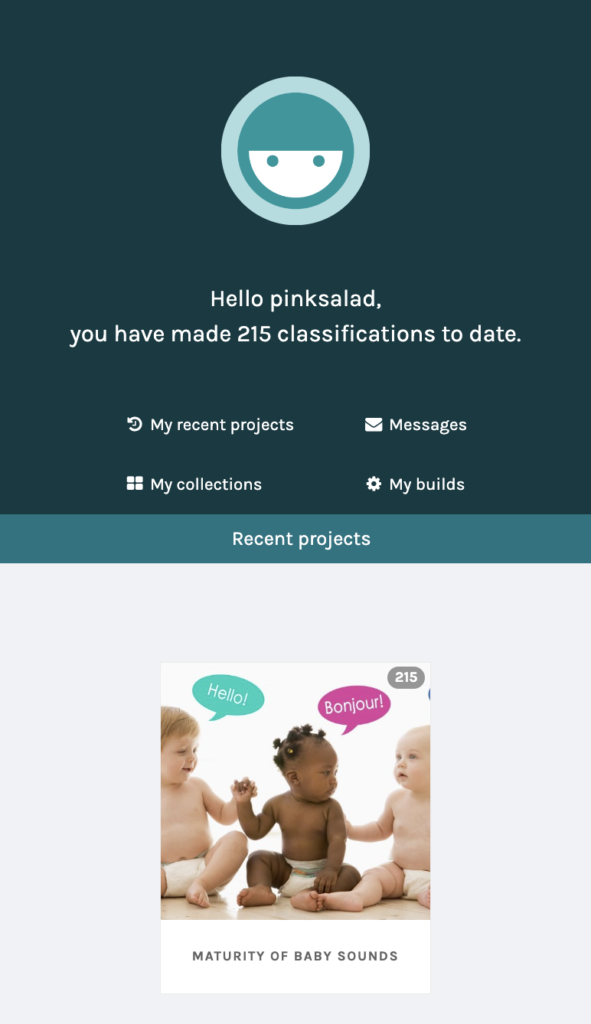
Image Above: My user profile in Maturity of Baby sounds stating that I had preformed 215 classifications
The main challenge that I observed in this project was feeling connected to the project and incentivizing continued contribution. I have not participated in many crowdsourcing projects as an adult. And I have forgotten most of my other experiences. My most recent was transcribing documents with the Library of Congress in 2020. I think I was prompted to participate by an article suggesting it as an uplifting thing to do while in lockdown. I had previously been volunteering in person to help with the digital collections of a local college until the pandemic interrupted our work. Truthfully I enjoyed volunteering physically in the library the most and having access to the collection to browse and get more context for the project I was working on simply out of curiosity. The second best experience was the library of congress, which let me read through pages that had already been fully reviewed alongside the pages still being actively transcribed. In comparison, the Maturity of Baby sounds felt disconnected. Perhaps I would feel more connected to the work if I had read the papers that had been published based on the previous version of the project. My experience makes me think that other volunteers may be motivated to volunteer for similar reasons to me. They would want to feel as though they are contributing to useful knowledge and also want to feel close to museum collections. I think the creators of Maturity of Baby Sounds knew this was a motivator based on the language they used to encourage volunteers to participate which is a great first step. However, I really do think that the feeling of closeness is hampered by how obscured it can be to tell what organizations are involved in zooniverse projects. I am not sure why zooniverse does not use this to draw in more volunteers who are familiar with the creators of projects but not the platform.
Zooniverse’s tracking feature did make me feel incentivised by counting each individual categorization as I worked. In comparison, I remember disliking the nebulous way the Library of Congress tracked my progress (in hours spent participating) although I think this may be useful to students who are working to get volunteer hours for school. The talk forums also turned out to be more friendly and informal than I initially thought, and I wished I had used them sooner. Features like these can make volunteers feel as though what they are doing is part of a bigger project.
As we discussed in class, many institutions worry that digitized or online components will allow visitors to substitute virtual interactions for the traditional visits that usually keep institutions afloat. However, I think the experience online provides a completely different kind of relationship to the institution. Watching contribution trackers tick up, progress bars fill in and whole projects reach completion gives volunteers a sense of pride and responsibility. I think the benefit of this is that volunteers will feel a more personal stake in the host institution. As I have stated multiple times, I am baffled as to why the institutions on zooniverse do not all prominently feature their names in their projects. It is a way to get people interested on both sides, the main institution and the crowdsourcing effort. In a time when so much content is over branded and over advertised, it would be refreshing to have a credible resource link to a genuinely related and exciting space for interaction. The next step is for more institutions to tastefully integrate all aspects of their online presence into their identity to reach people wherever is most accessible to them.

Leave a Reply
You must be logged in to post a comment.