By: Ness Goenaga
Date: 12/03/23
The institution I decided to look through was the Smithsonian museum, and I was specifically looking for ways in which I can participate digitally instead of in-person. On their website, volunteer opportunities are divided into three categories:
Engaging Visitors, Behind-the-Scenes, and Short Term/Seasonal.
I liked how they separated the volunteer opportunities into these categories. It helps people locate the type of service they would like to contribute. Some people might prefer to be more active and interact with others, while some prefer to work individually. Seasonal is good for those who would like to contribute during a specific time period or event. The categorization concept is good, but the page needs to be improved and updated. I found some links that were non-functional.
- I specifically chose to do the Transcription Center, as it fits my need to volunteer remotely.
For my analysis of this program, I will be breaking it down into different sections, before going into my review of the process, and conclusion.
Program’s Date of Creation: June 2013
Methods for Promoting the Transcription Center Program
- Monthly Newsletter: Users can subscribe to the mailing list or add it through an RSS feed. (Newsletter archive goes back to 11/12/2021 and is still ongoing.
- Monthly Community Chat Online to engage with Transcription Center Staff and fellow Volunpeers. Next Session : Friday, 12/15/23 at 3:00PM via Zoom.
- Blog run by Smithsonian Marginalia created in 2018.
- Social Media Accounts on Facebook, Instagram,Twitter, and Youtube:
| Social Media Site | Creation Date | Followers | Posts | Last Upload |
| Jan. 2014 | 5.4k followers | 2 posts/week | 08/18/23 | |
| Nov. 2014 | 7.7k followers | 485 Posts | 11/24/23 | |
| Tumblr | Mar.2014 | Unknown | 970 Posts | 07/28/17 (Inactive) |
| Dec. 2013 | 13.8k followers | 19.4k Posts | 11/20/23 | |
| Youtube | Oct. 2014 | 380 | 69 videos | 03/20/23 |
Additional Notes:
This program has managed to keep engaging their users by consistently posting and sending them information about all their projects through different communication channels. Some of the messages are more of an open invitation with the function of providing information about projects to the general public, Other messages are tailored for those who are registered and have previously participated in specific projects already.
They have website pages for gathering feedback from their users, and they have methods of contacting registered users through the email they signed up with. It is important to encourage and show appreciation for their efforts, this could be in the form of a gratitude email.
They refer to the volunteers as “Volunpeers” so that they feel a closer connection to the museum and establish better community ties.
Volunpeers are also encouraged to share their findings with others through social media.
The creation of transcribing or reviewing monthly challenges help promote collaboration between participants.
Further Incentives: Behind-the-Scenes information in exchange for their altruistic services.
Statistics on Home Page:
- Total Pages: 1,305,668
- Transcribed Pages: 1,297,176
- Volunpeers: 84,123
(Number possibly does not reflect active users but the total number of participants or registered users throughout the years.)
Maintenance/Recent Activity:
Last patch for bug fixes was Oct. 23, 2023.
These projects are constantly being worked on and completed.
* Status: Site is regularly updated and maintained, important for continuing to keep the program operating.
Instructions:
Instructions can be found on their homepage by clicking on the Tips button located on the right of the top header.
Link: https://transcription.si.edu/tips
The instructions are broken down into different categories:
- General Instructions
- Advanced & Specific Project Instructions
- Community Guidelines
- FAQs
- Tracking Your Volunteer Service
- Hosting a Transcribe-a-thon
- For Educators
There was also a Youtube video guide at the top. For My purposes I only read the General Instructions and FAQs and watched the video.
User Error Prevention:
- Before beginning to transcribe there will be a pop-up asking if the user has read the guidelines. It provides the link to redirect them to the guidelines page if they have not.
- Only one person can work on a document at a time. This is so that there are not two people making edits or transcribing over each other.
- Once someone has transcribed a document, it is put under the review process. In order to gain access to review, users must first create an account.
- After a document has been transcribed and reviewed by volunpeers, Smithsonian staff approve the document before it is finalized.
Note: There is a lack of age verification for transcribing documents, although there is a requirement for reviewers, before it is shown by staff.
Search Functionality:
- Users can search across different museum sections for transcription projects.
- Categories can be found on the museum/archive or theme list.
- Projects can be sorted Alphabetically, Latest, Most Popular, Least/Most Completed.
- Projects can be searched by Difficulty Level; there are five level settings:
| -1- (Beginner) | -2- | -3- (Intermediate) | -4- | -5- (Advance) |
| Print Text | Cursive Text | Data, Columns Number, Images |
Personal Experience:
When I initially started, I went straight to looking at the projects available and played around with the search functions by using the filter to find the projects that were least completed. I clicked on the first one that appeared. I wanted to get first hand experience on how it works, so I did not read the guidelines before starting. Thankfully, a pop-up appears asking if I have looked at the guidelines, and provided a link I could follow to read them. After reading, I restarted my search as I realized I can look for projects by difficulty level. The lowest level I could find was 3 (Intermediate). This level requires the transcriber to be able to read cursive, which is within my comfort zone. I would probably struggle with level five (advance) which requires the transcriber to be able to read and format data, possibly into columns. This would apply for the documents like the Project PHaEDRA – Muriel & Sylvia Mussells – South Polar Cap Magnitudes, W. #G68 which has to do with astrophysics.
I transcribed a page for the Jacques Seligmann & Co. records, Museum Correspondence: São Paulo, Brazil, Museu de Arte, 1950-1959. Sometimes I would have to stop to attend to something else, and it would give me a pop up asking if I was still active. The interface allowed me to zoom in and out, reset. There were a few other tools, but that was all I needed for this page.I managed to complete it and submit it. I could then see it was put under the review process.
Sample of Contribution:
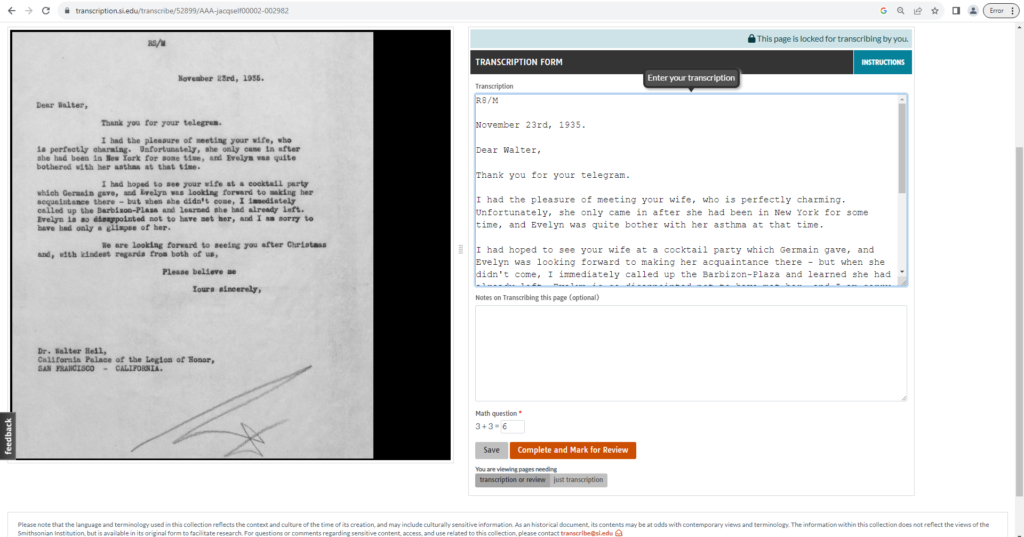
Conclusion:
I did not have that much personal experience participating in museum projects previously. I was really impressed with how the Smithsonian has developed the transcription center, and how much they were able to accomplish through the contributions of volunteers. The three-step process of transcribing, reviewing, and approval that they undergo for their documents is very efficient with an accuracy rate of 99%. It is more accurate than some optical character recognition software (Parilla & Ferriter, 2016). The infrastructure for this program provides users with a nice interface and good search functionality, so they can find a task that fits their skill set and have it relate to a topic that interests them. This site was planned around 2012, and then it was created in roughly 3 months using three different teams for :data architecture, data interactions, and user interface/user experience (Gunther et al., 2016). It is still regularly updated to maintain the site and continue making improvements.
Continued engagement from users hinges on social media and public relations communication efforts. They maintain a variety of social media accounts and collaborate with other internal departments within the museum and other institutions to promote or collaborate with projects.The Smithsonian transcription interval campaigns are used to gather a spike in interaction and gather new volunteers to the program. They however do struggle with retaining long term users, which I imagine is a challenge every museum faces. It requires constant active engagement with the public to keep momentum going.
I think that the most difficult challenge about all this is budget because it seems that in order to get these contributions you will need money to maintain the site’s functionality and its social media presence. This would require a skilled IT and social media team, and also the coordination between museums’ curators and archivists. Also the staff that must also approve documents before they are finalized is also extra time.I think the benefits definitely outweigh the costs in the long term when you have actually seen how many projects have been completed as a result. Although a project of this scale is not feasible for a lot of museums who don’t have the funds to set up something like this. This is just one example though since museums have lots of other ways for people to contribute and volunteer which does not have to be so technologically reliant. Volunteering to be a museum tour guide, helping with programming, field research, etc.
Despite how different each museum might be and their programs, I think it is reliant on being able to use whatever resources you have efficiently within your disposal and creating a clear executable plan by collaborating with the whole of the museum staff. The second half relies on involving the public throughout the development process and continued iterations of a project through their feedback. Third would be creating a way to measure performance outcomes as a result of a program, it was very surprisingly easy to see the transcription center’s progress. Overall, the three principles that all museums should focus on would be organization, communication, and continued development.
Additional Sources:
Ashenfelder, M. (2016, December 21). “Volun-peers” Help Liberate Smithsonian Digital Collections | The Signal [Webpage]. The Library of Congress. //blogs.loc.gov/thesignal/2016/12/volun-peers-help-liberate-smithsonian-digital-collections
Gunther, A., Schall, M., & Wang, C. (2016). The Creation and Evolution of the Transcription Center, Smithsonian Institution’s Digital Volunteer Platform. Collections, 12(2), 87–96. https://doi.org/10.1177/155019061601200203
Parilla, L., & Ferriter, M. (2016). Social Media and Crowdsourced Transcription of Historical Materials at the Smithsonian Institution: Methods for Strengthening Community Engagement and Its Tie to Transcription Output. The American Archivist, 79(2), 438–460. https://doi.org/10.17723/0360-9081-79.2.438

Leave a Reply
You must be logged in to post a comment.