Creating a virtual exhibit using the Exhibit.so system is quite daunting, initially. For an individual who does not consider themselves tech-savvy, creating a virtual exhibit from scratch seems impossible. The verbiage used in this process can be confusing. Manifest? URI? However, once the process becomes clearer, one discovers the interconnectivity of virtual images and metadata, and the benefits of linked open data.
Because I was still unclear on the assignment, I began to conduct further research to learn more about how to use IIIF and create virtual exhibits using Exhibit.so. No surprise, many YouTube videos went in-depth on the topic. One of the videos I watched was a virtual workshop created by IIIF staff that goes into great detail about creating exhibits using Exhibit.so. Before watching the videos, I feared I needed coding skills to create the exhibit page, especially after seeing the URI page in class. It was all Greek (or geek) to me, only joking.
I also visited the IIIF training page to learn more about how IIIF works with Exhibit.so. The IIIF training page provides brief overviews on a variety of topics from scaling and formatting images to the different modes of Image API and Presentation API. For users, the experience is supposed to be seamless. Where Image API provides the user with a high-quality image to which they can zoom into areas of interest in the image, particularly useful if the image includes something handwritten, Presentation API provides the background info, metadata, and context for the image.
After watching the video, I felt much more confident in my ability to complete the assignment. When I searched for manifest links, I was directed to the top search result CURIOSity which is a digital collection curated by the Harvard Library. It offers content on a variety of topics from Literature, Education, and Science, to Art and Music.
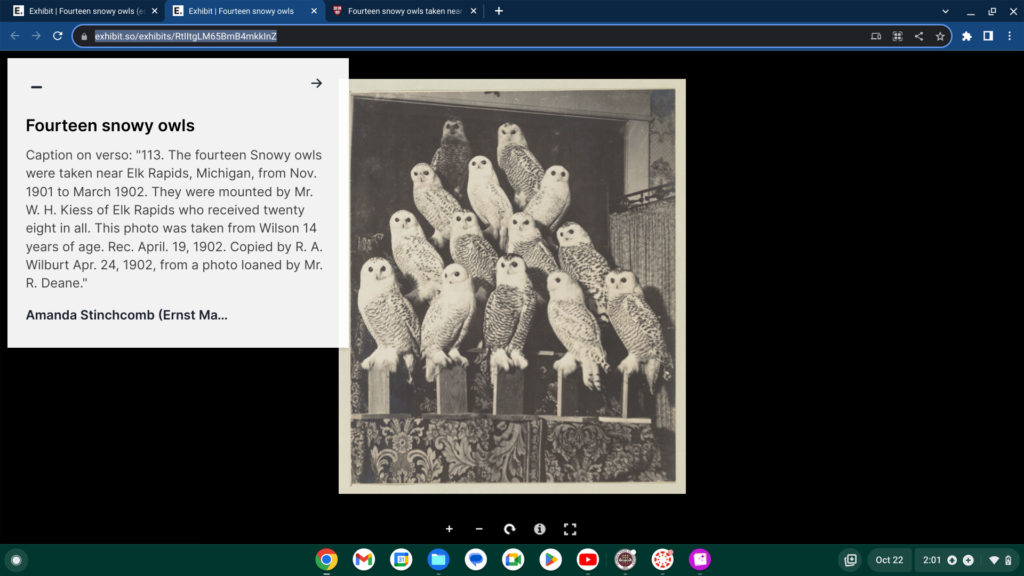
After scrolling through the list of topics, one particular image caught my eye. Because I love birds, I clicked on the William Brewster ornithology page. There, I found a very curious photograph of fourteen stuffed and mounted snowy owls. I thought it would make an interesting addition to my virtual exhibit. CURIOSity made it easy for me to copy and paste the manifest link (https://iiif.lib.harvard.edu/manifests/ids:445000141) into Exhibit.so, because it provides that (and other important metadata) right on the item’s page.
The first challenge I experienced using Exhibit.so was understanding where the “Create an Exhibit” button was located. As a user, the location of this button, found at the bottom of the page, does not seem very intuitive. It is also not a large button and is easy to overlook. If I were the administrator of that page, I would consider making the interface a bit more user-friendly and intuitive, by moving the “Create an Exhibit” button to the top of the page and making it larger, for example.
The creation of the exhibit is a simple process. The creator needs only to input some basic information like Title, Description, and Rights, and “agree to the terms,” before they can publish the exhibit. With the initial exhibit, I did not experience any issues publishing the image using the link to the manifest, but when I tried to create another exhibit using another tab and image, it would not load in the preview. I was unsure if it was because it was an additional tab, or because I had too many tabs open at the time, but it was frustrating.
Systems like Exhibit.so have many uses in the library and museum world. Most librarians do not view other librarians as competition. There is an environment of collaboration because of their shared goal and vision of serving the community and providing access. Linked open data is a link in the chain of accessibility. Another important aspect of linked open data is equability. Sharing data provides users with a means of holding creators accountable for bias, misinformation, and inclusion. If more institutions adopt this type of system, it would reduce redundancy. Because institutions would utilize a common web identifier, it would streamline the search process as catalogers would not be responsible for creating records from scratch and would be free to pool resources across cultural heritage institutions and the web.
According to the World Wide Web consortium, because of the ever-changing nature of technology, linked data is “more durable and robust than metadata formats that depend on a particular data structure” (Benefits – Library Linked Data, n.d.). Its meaning does not change across formats. Linked data will open accessibility across institutions that will no longer be required to use software specific to their institution. Records will be timely and up-to-date because resources can be directly cited by catalogers.
Although there are many benefits that would improve user experience as a result of implementing this system, there are also some potential challenges. As this type of technology is still very new, there are technical issues that should be anticipated. One of those issues would be users being unable to understand the functions of the system because either it is too complex or because they lack digital literacy skills. New systems must be highly intuitive to accommodate various levels of digital knowledge. The new system might affect workflow. This creates issues for staff who are probably stretched too thin already. If the system is not efficient, it will cause problems for staff and users alike.
Another potential issue is that technical “infrastructure” must work together in a cohesive manner. If there are issues with compatibility across devices, networks, etc. this will prevent access. Also, as items and records are digitized, users are still facing access issues as a result of the digital divide. According to Ekosaari and Pekkola in their article about identifying digitization challenges in museums, technical issues surrounding digitization primarily stem from “Organizational culture that produces heterogeneous data (Content) that is difficult to aggregate; Technical issues, largely caused by the systems renewal and migrating heterogeneous data; and Legal issues that restrict publishing aggregated data.” However, lack of resources is also a significant issue for the implementation of these systems across institutions.
Overall, the benefits of implementing linked open data systems far outweigh the costs. New and more efficient systems are being developed all the time. It is the responsibility of cultural heritage institutions to make information available to users, because most of these institutions, like libraries, have a shared vision of providing equal and equitable access to information to their communities.
Benefits – Library linked data. (n.d.). https://www.w3.org/2005/Incubator/lld/wiki/Benefits#:~:text=Benefits%20to%20librarians%2C%20archivists%2C%20and%20curators,-The%20benefits%20to&text=The%20use%20of%20shared%20identifiers,from%20the%20Web%20at%20large.
Ekosaari, Maija, and Samuli Pekkola. Pushing the Limits beyond Catalogue Raisonnée: Step 1. Identifying Digitalization Challenges in Museums. 2019.
Overview · IIIF Online Workshop – June 8th to 12th 2020. (n.d.). https://training.iiif.io/time_machine/


Leave a Reply
You must be logged in to post a comment.