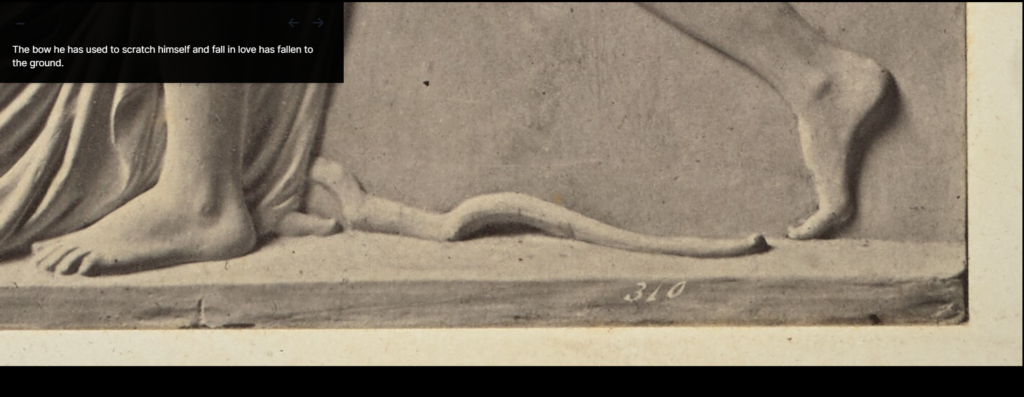
My exhibit, titled Cupid and Psyche, was made in exhibit.so because I wanted to experiment with creating an online exhibit with an interactive element. I selected a photograph of the marble relief Cupid Kissing Psyche by John Gibson that is held by the Royal Academy of Arts. The photograph of the relief was taken by James Anderson in 1859 and is from the collections of the Getty Museum.
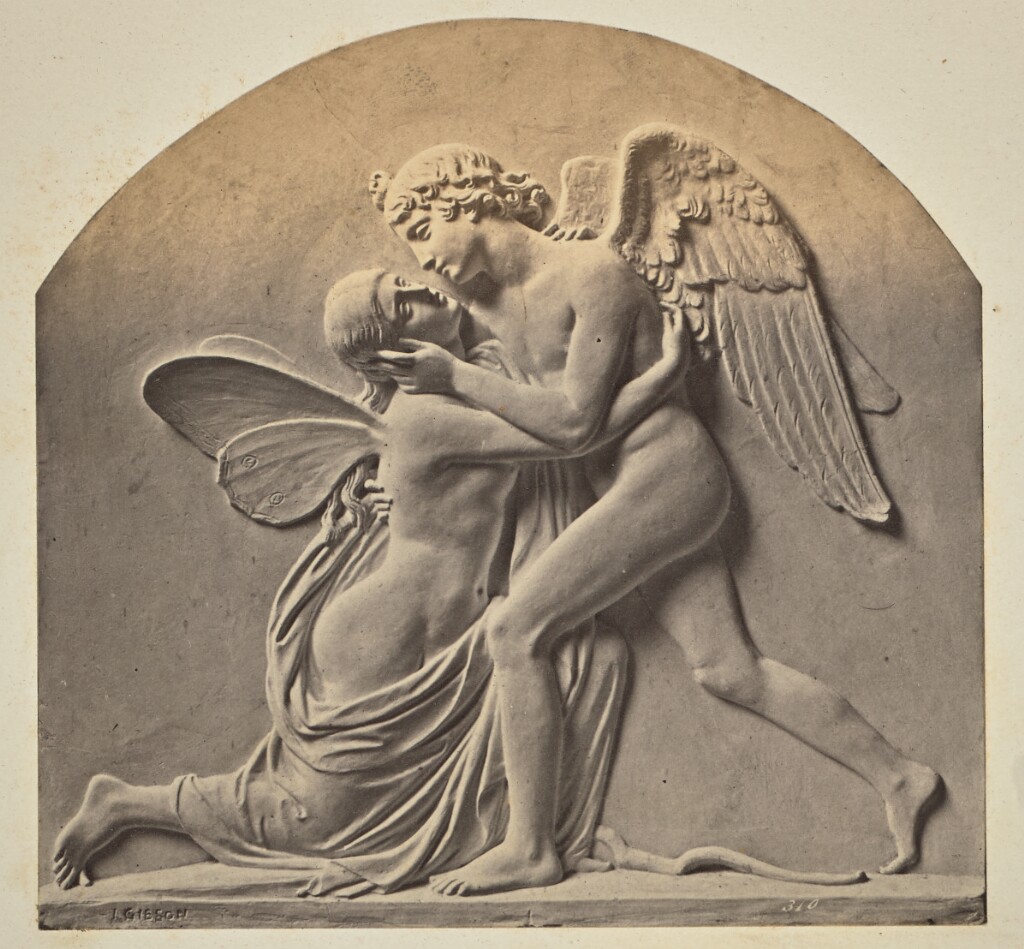
The artwork tells the Greek myth of the mortal Psyche and god Cupid and their journey to love and marriage. The relief contains several symbols from the story, including wings and arrows.
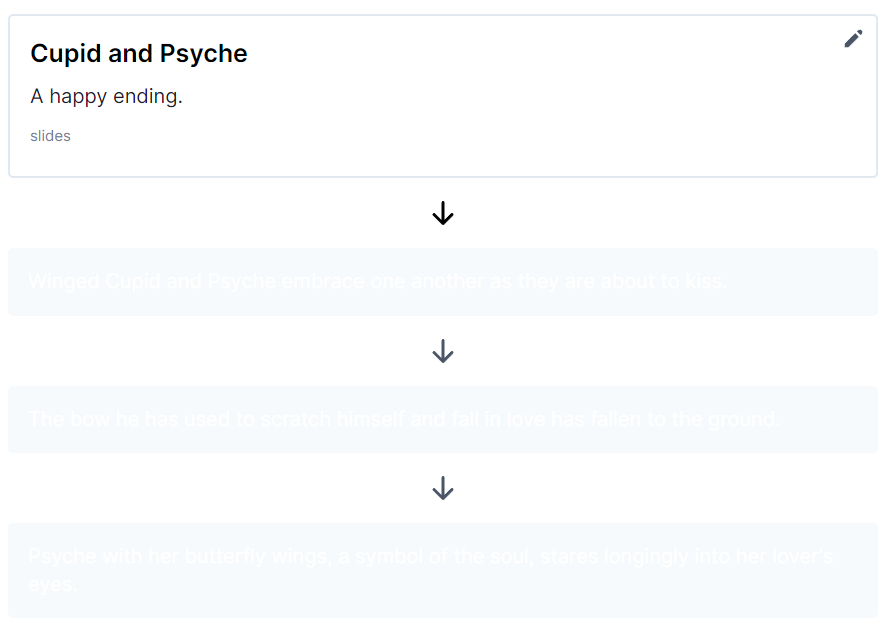
For this assignment, I decided to incorporate elements of the myth into a very brief exhibit using an artistic depiction of the myth. This was the first time I’ve used exhibit.so and there was a bit of a learning curve understanding the unique way images are presented on this interface. I had no issues creating an account and setting up the basics for the exhibit, such as title and description. After uploading the image, the zoom feature was confusing. It was unclear that zooming into the image on the backend would result in a zoomed image in the exhibit.
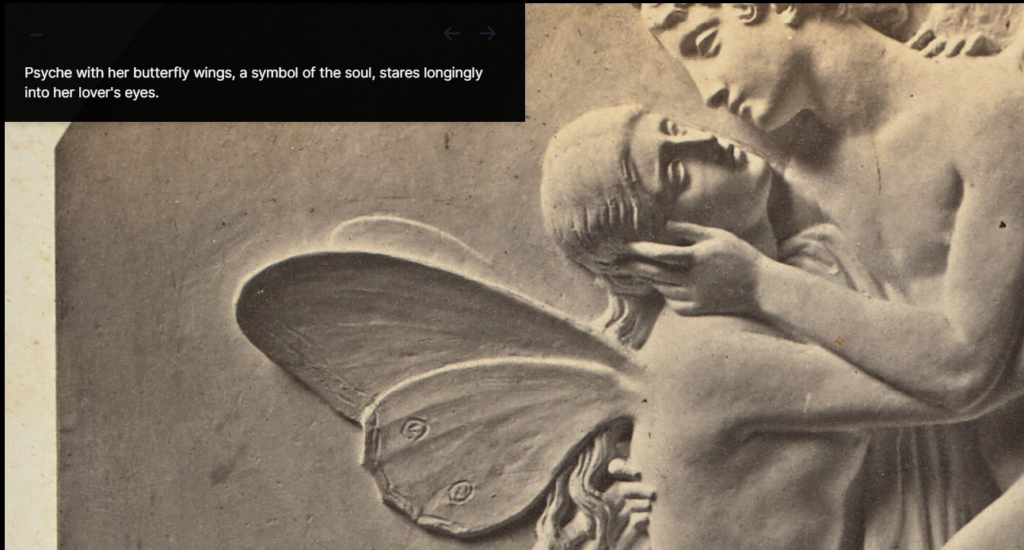
Likewise, the user can customize the text appearance, but the preview on the backend doesn’t show you how it will look. I wanted the text to be white on a black background, but on the backend, the white text was impossible to read, so I had to keep looking at the preview window to make sure the content was accurate.
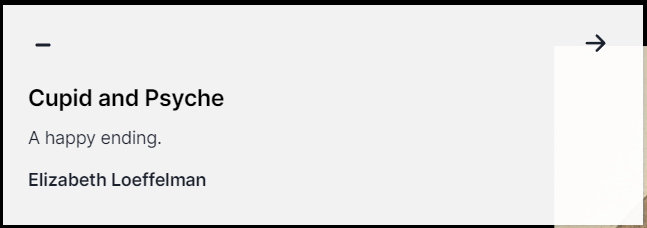
I also wasn’t a fan of how the author’s name appears on the first slide. I thought it was distracting and confusing because the presentation didn’t specify that it was the author’s name. The field is required, so instead of putting text, I put a space, which made that field disappear on the public-facing exhibit.
Despite these issues, I do find this system interesting and can see the potential benefits of museums using it. I think creating short and engaging exhibits that take a closer look at an artwork and are freely available online could get more people engaged in a museum’s collection. By focusing in-depth on a specific work, the museum can keep the user’s attention while teaching them about the work’s history and/or meaning. Having a mobile-friendly interactive exhibit, like those found on exhibit.so, will engage people on the mobile device they’re comfortable using while educating them about art history.
Barry (2006) writes that there must be a connection between the in-person and virtual space, the so-called “virtuous circle,” and museums “must ensure that all content development consider multiple platforms and delivery channels when developed, including kiosks, Internet, PDA, mobile and broadband, and that it must look for opportunities for cross-fertilization where possible.” Having an exhibit.so online exhibit that can go deeper into an artwork’s meaning could further enhance the museum experience. Wall panels have limited space available, so an interactive online exhibit could provide an opportunity for further education and engagement.
I also think incorporating exhibit.so into in-person exhibit creation or public outreach could benefit library, archives, and museum professionals by utilizing their research more widely. Having worked in libraries, archives, and museums, I remember how frustrating it would be to spend so much time researching and understanding a record, artifact, and artist and then only about 25 percent of that research could be incorporated into the exhibit due to space limitations. Exhibit.so could create an opportunity for some of that research to be used in short snippets. For example, say an artwork features a butterfly, the short online exhibit could dive into how butterflies are symbols of resurrection and rebirth and how that’s represented in artwork held in a collection.
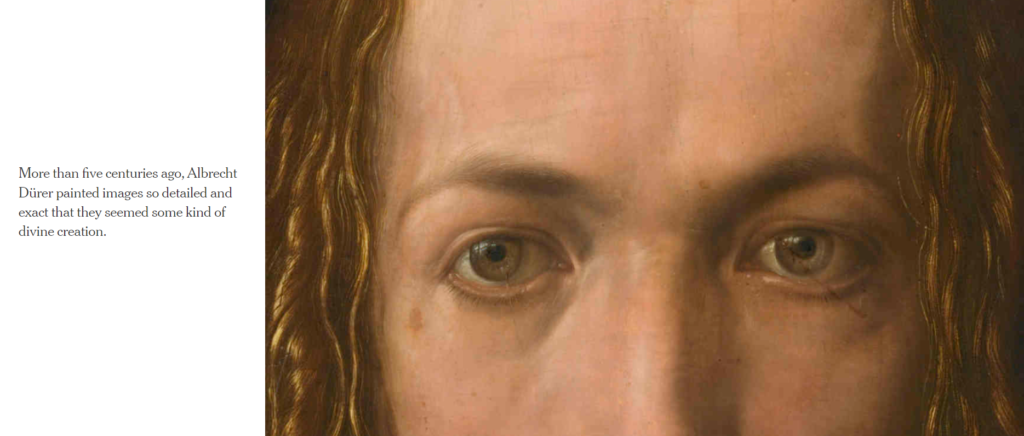
The functionality of exhihit.so reminds me of The New York Times’ Close Read series that has a similar interface and zooms into artwork and letters and provides text for additional context. The New York Times incorporates high-resolution images into their storytelling so the user can get a closer look at an artwork in a way that one could never get at a museum. A 2020 Close Read examined the birth of the self-portrait through the work of German painter Albrecht Durer (Farago, 2020). I think museums could take this approach and really dive into artworks in their collections to engage the public.
There would also be challenges for library, archives, and museum professionals to implement a broader policy with exhibit.so. The primary issue being limited staff time to create and maintain yet another platform. With limited staff but ever-increasing social media platforms, website updates, and in-person exhibits, it would be a challenge to find time to create the content for exhibit.so. It takes time to digitize the artwork, do research, create the exhibit on exhibit.so, and then share and promote the exhibit on the museum’s website and social media accounts and with media contacts.
For the simple exhibit I made for this class, it took me at least an hour to make sure my interactive zoom was correct, that the text made sense, and that the presentation was how I wanted it to look. And that was just one artwork I downloaded off the web! Creating a professional exhibit on behalf of a museum would require much more effort.
I think another challenge will be raising awareness about the online exhibit component. Libraries, archives, and museums seem to have a challenging time promoting themselves, so I think a concern is how to promote the online content in a way that the public would take time to look at it. With the time and monetary investments that come with creating an online interactive exhibit, it will be a hurdle to promote it, especially if there isn’t a designated marketing department.
Despite these challenges, exhibit.so is an interesting tool that has many possibilities for library, archives, and museum institutions.
Resources
Apuleius. (1998). The golden ass (P.G. Walsh, Trans.). Oxford University Press.
Barry, A. (2006). Creating a Virtuous Circle between a Museum’s On-line and Physical Spaces. In Trant, J. and Bearman, D. (Eds.). Museums and the Web 2006. Toronto: Archives & Museum Informatics. http://www.archimuse.com/mw2006/papers/barry/barry.html
Farago, J. (2020, September 25). Seeing Our Own Reflection in the Birth of the Self-Portrait. The New York Times. https://www.nytimes.com/interactive/2020/09/25/arts/durer-self-portrait.html

Leave a Reply
You must be logged in to post a comment.