Have you ever played the parlor game “Six Degrees of Kevin Bacon?” In the game, you pick an actor and then try to recall connections to other actors or films that will lead you to Kevin Bacon in six steps or less. The path from any actor to Kevin Bacon is an example of “Linked Data.” And “Linked Open Data” (LOD) is considered to be a set of best practices for publishing freely distributed data on the web (Posner, 2021).
In my professional life, I write a lot of SQL queries against relational databases. With this assignment, I wanted to take a look at link data technologies to understand the language similarities of SPARQL used with a resource description framework (RDF). Similar to relational databases, LOD uses unique IDs called Uniform Resource IDs (URI) that allow the joining of the data between entities. Anything can be given a URI. As long as it is unique, anyone can join entities using that ID to retrieve the exact record they are seeking. Within RDF, link data is inserted into statements using the subject, predicate, and object format. This format is also referred to as a “triple.” “Kevin Bacon starred in the movie, Footloose” is an example of an RDF statement, or a triple.
Wikidata and DBpedia are two link-open, data projects built around Wikipedia (Idehen, 2019). “DBpedia’s focus is on generating Linked Open Data from Wikipedia documents. Wikidata’s focus is on creating Linked Open (meta)Data to supplement Wikipedia documents” (Idehen, 2019). Both use SPARQL endpoints to enable access to the data.
Using a YouTube tutorial from The University of Edinburgh’s Wikimedia residency, I followed along and learned how to link data with Wikidata (Evans, Navino, 2017). The basic structure of a SPARQL statement is similar to SQL.
| SQL | SPARQL |
| SELECT * FROM tablenameWHERE | SELECT *WHERE { } |
In the tutorial, I opened Marie Curie’s Wikipedia page. Under tools, there was a link to the Wikidata item. Within Wikidata, I noted that Marie Curie’s unique ID is Q7186. Scrolling through the Wikidata page, statements are listed that could be linked to Marie Curie. For example, occupation is one of the statements, and “chemist” is listed as an object under occupation. A Wikidata Query Builder can be used to write a query to locate chemists by crafting an RDF statement specifying a where clause condition that looks for any person with the occupation of “chemist.” In place of the word “occupation” in the query, the “wdt:” prefix is used along with an ID “P106.” “P106” translates to “occupation” in the Wikidata ontology. In place of the word “chemist” in the query, a “wd:” prefix is used along with the ID “Q593644.” You do not have to memorize the IDs to use them. Query help can be obtained by selecting ctrl+spacbar after you type the prefix. A selection box will appear where you can type the word “occupation” and the ID will populate for you. You can see this example in the image below.
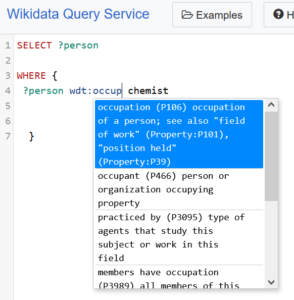
My query for chemists within Wikidata yielded 29844 results.
SELECT ?person
WHERE {
?person wdt:P106 wd:Q593644
}
The “?person” command in the select statement above gives you the ID for the person but does not give the names also known as labels. To add the names, we add ?personlabel to the SELECT statement and apply the label service statement in the where clause. This will display the query results as two columns: the Wikidata ID, and the person’s name. To narrow the results to only female chemists, another where clause condition that restricts the gender of the query to “female” is added. However, the newly modified query still yields 4196 results. Your result sets should get smaller the more statements you add to the where clause. The query below also adds the property of birth location with the entity of “Warsaw” and asks that each result include an image of the person. This final query yielded 6 results and one of them was Marie Curie.
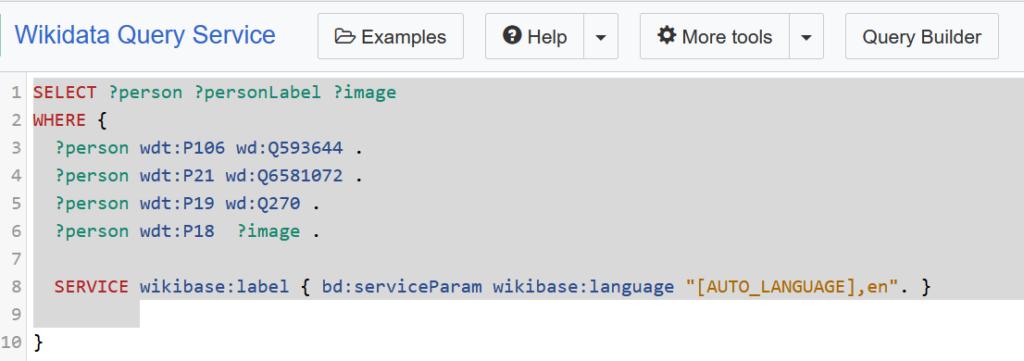
Link here to see the results of the query
Turning to the DBpedia SPARQL endpoint, I wanted to execute the same query to locate a female chemist; born in Warsaw, Poland. I easily found the DBpedia page for Marie Curie. The page has all the statements that could be used to connect her data to others. I found the r.type for chemist and female. I also specified the birthplace (dbo:birthPlace) of Warsaw (dbr:Warsaw). My query yielded only one result in DBpedia instead of six, and Mare Curie was the only result found.
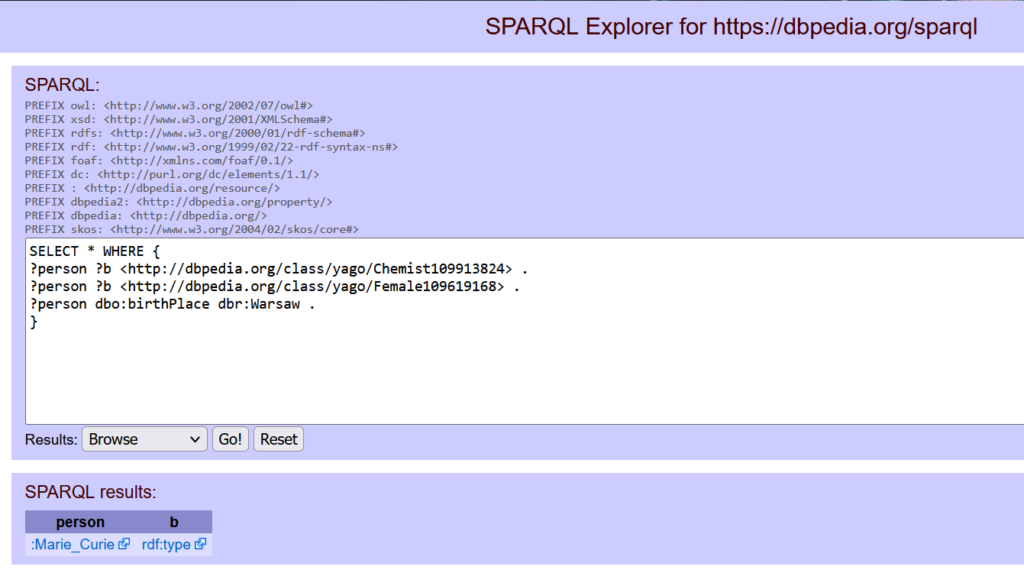
Within the Wikidata results, Grażyna Lipińska is another female chemist born in Warsaw. However, the same person in DBpedia only had a property linking back to a cemetery. There were no other properties that would join her to Marie Curie as a female chemist like Wikidata.
Wikidata was easier for a novice like me to write and retrieve results from the SPARQL query. The ctrl+spacebar lookup allows a user to type in the word they were looking for and insert the auto-populated ID into the code. It also had several result layouts from tables, image grids, timelines, and maps available. The DBpedia requires a user to look at the URI for each of the items in its extension ontology. It was time-consuming but in time I was able to figure it out.
As museums move toward displaying their collections digitally, possibilities of linking data from one museum to another increase, creating a wealth of knowledge on the web for the academic world. Imagine playing the same Six Degrees of Separation game with, for example, paintings by Claude Monet. Or imagine being able to locate all of Claude Monet’s works in multiple museums around the world. The use of linked data from museums can make the collection accessible to a larger audience than patrons who can physically visit the museum (Canning, 2021). The combined collection of data on historical items can be very beneficial for researchers and academics wanting to explore those items in greater depth (Canning, 2021).
Drawing on the description of resources from across other cultural heritage datasets and the use of shared identifiers will make it easier for the curators to catalog their data (Benefits – Library Linked Data, n.d.). Databases should always be more than just the storage of data. They should also allow users “to create meaning” from the data collected (Canning, 2021).
Several challenges accompany the benefits of using Link Open Data with libraries, archives, and museums. Each of the institutions needs to employ a cataloger who focuses on the link data framework. Many of these institutions already have their data within relational databases which are the ideal framework to connect to other institutions who will have their framework in place. For Link Data to work, time and labor are required to add the correct identifier to each item in their collection so it can be linked. There is work being done to develop software like “Heritage Connector” that could aid in the linking of the data connecting museum collections to Wikidata which would make this process faster and possibly less costly (Dutia & Stack, 2021). It will be interesting to watch the development of such technology over the next few years.
Benefits—Library Linked Data. (n.d.). Retrieved October 28, 2023, from https://www.w3.org/2005/Incubator/lld/wiki/Benefits
Canning, E. (2021, September 22). Seeing Your Data Differently Through The Lens Of Linked Data. MCN. https://mcn.edu/seeing-your-data-differently-through-the-lens-of-linked-data/
Dutia, K., & Stack, J. (2021). Heritage connector: A machine learning framework for building linked open data from museum collections. Applied AI Letters, 2(2), e23. https://doi.org/10.1002/ail2.23
Evans, Navino (Director). (2017, October 19). Building SPARQL queries—Wikidata tutorial by Navino Evans. https://www.youtube.com/watch?v=b3ft3CzkLYk
Idehen, K. U. (2019, June 25). On the Mutually Beneficial Nature of DBpedia and Wikidata. OpenLink Virtuoso Weblog. https://medium.com/virtuoso-blog/on-the-mutually-beneficial-nature-of-dbpedia-and-wikidata-5fb2b9f22ada
Posner, M. (Director). (2021, January 7). What is Linked Open Data? https://www.youtube.com/watch?v=VZBpFiLbi-Y

Leave a Reply
You must be logged in to post a comment.