For my digital systems assignment, I decided to use exhibit.so since it was the site that was recommended for beginners. It uses IIIF (International Image Interoperability Framework) manifest URL for creating the digital objects for a collection. The IIIF is a data standard which was designed by the cultural heritage community to make creating, sharing, and editing their digital objects easier and more efficient (Uchitelle, 2019). As suggested in class, I went to the official IIIF site to find museums that provide the IIIF manifest URLs to the public to use.

I created a google document to store the URLS and plan my descriptions for the items; this is also where I was able to keep my link for editing. This was due to the possibility of the site crashing from overload and not saving my progress, but it also just helped organize my thoughts and keep my references around. I did not experience a crash, but when I did try to auto-correct a typo my entire paragraph was deleted. I’m glad I took that precaution and avoided unnecessary frustration.
The possible functions for how the IIIF can be utilized is dependent on the IIIF viewer that is chosen. Exhibit’s site allows for the usual deep zoom of an image which shows impressive detail of the item, and the descriptive metadata from the IIIF manifest is carried over as well. It makes it easy to share, analyze, and study pieces across different institutions.
The main function of the Exhibit.so site however is the ability to add annotations and to create new slides in an arranged sequence using different portions of the image. You can use four templates for displaying the items which are: slides, scroll ,kiosk and quiz. I was interested in this function, as it seems like a great feature that can be used for educational purposes and a bit of interactivity. The quiz template allows the user to add multiple-choice questions and specific pinpoints. There is also the kiosk version which provides a duration timer for the slides. I’m not exactly sure how that would get on a kiosk, but maybe it is with the web embed feature. Some of the uses for regular annotation for slides/scroll template would be to provide more context or narrative storytelling for an online exhibit.
Here is the URL provided by exhibit.so. Password: lis5590 https://www.exhibit.so/exhibits/87rTMYnx5PzDNLt6fGuj
The site was not that intuitive, as there are few indicators confirming if you have made a new slide or not. I also did not realize you can rearrange them initially. You can only view how your exhibit will appear by using the preview button. However, it was easy to figure out when you actually read the site’s instructions found on the Docs tab on their home page.
I decided to use Homer Wilson’s painting, Returning Fishing Boats retrieved from the Harvard Art Museums website to start creating my first slides. I had written 2-3 paragraphs of text based on my observations which could be used for my annotations, although I kind of imagined it as an alternative text. I created 6 slides from my spliced description showing the painting from different angles to highlight the points of my description. I did this only utilizing the interface for exhibit.so without modifying the URL of the item.
IIIF has the potential of saving costs for LAM institutions, as they do not have to create their own code from scratch or figure out how to format their images every time. If this becomes the standard for all institutions there is also a greater likelihood of actually being able to maintain and preserve the digital objects that they have painstakingly created for their collection. Usually when there is effort created to code and create their own private system there is a higher risk of it not being supported in the future, so having a community source seems more secure.
IIIF also just helps make these resources more accessible. It makes loading images easier which is important to take into account for areas that do not have fast broadband. It loads portions of the image using a tile system, which would prevent the item taking forever to render (Harvey, 2021). One image can be used across a variety of different platforms instead of creating another resource and uploading the information again. It also utilizes annotation functions following the W3C guidelines.
It also allows for greater learning opportunities and studies because of its main functionality to pull from multiple resources and compare them directly to one another. There are even IIIF viewers which have the function of overlapping or an x-ray function which allows you to see the different versions on top of one another to notice different details you might not have noticed before (Uchitelle, 2019; Harvey, 2021).
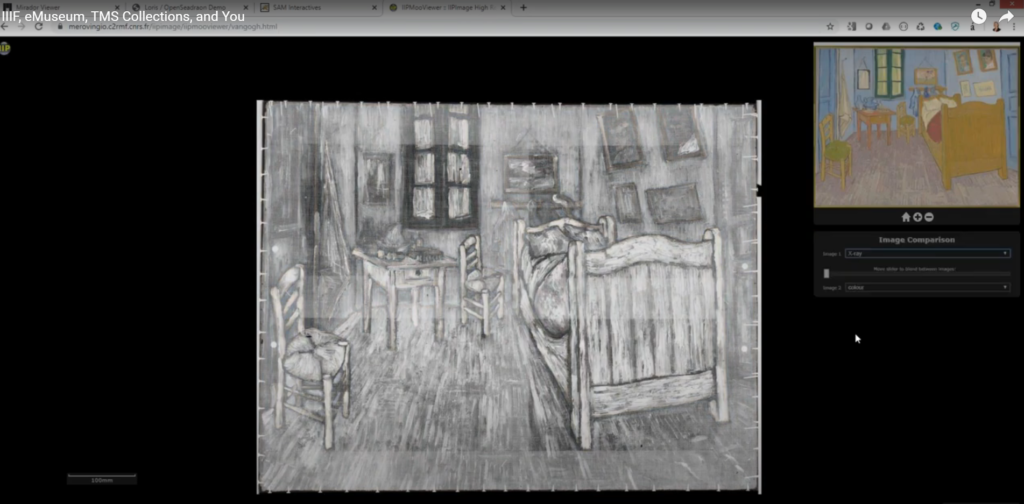
The most challenging aspect about getting everyone to adopt this standard would be the actual process of implementing it across all LAM institutions. It would be difficult to get everyone to create their resources this way, especially if they already invested in doing it a different way. I am not exactly sure how difficult it would be to convert previously made digital objects, or how much coding that would involve. Also this is kinda similar to the challenges and benefits when it comes to linked open data. It is easier for people to locate, utilize, and access these resources, plus the data itself would be more vast and richer. On the other hand there are concerns about the rights of the resource possibly, and how it should be utilized, or the possibility of people using a museum less because of it.
It also is reliant on the continued production and maintenance of IIIF viewers like Exhibit.so. I know that the main concern is just trying to get digital resources to use the IIIF standard, but the fact that there are so many options is a bit overwhelming to me. I think that there are many that are still in development and they kinda feel like they are in beta stages in a way. I think it offers infinite potential moving forward though as they continue to improve upon it.
References:
Exhibit. (n.d.). Welcome. Exhibit. Retrieved October 23, 2023, from https://exhibit.so/docs
Harvey, A.. (2021, February 18). Taking the IIIF online workshop. Medium. https://iiif-io.medium.com/taking-the-iiif-online-workshop-56b23b50ddca
International Image Interoperability Framework. (n.d.). How it works. International Image Interoperability Framework. Retrieved October 23, 2023, from https://iiif.io/get-started/how-iiif-works/
International Image Interoperability Framework. (n.d.). Image API 3.0. International Image Interoperability Framework. Retrieved October 26, 2023, from https://iiif.io/api/image/3.0/Uchitelle, D. (2019, November 19). IIIF: What is it and what does It do? Gallery Systems. https://www.gallerysystems.com/iiif-what-is-it-and-what-does-it-do/

Leave a Reply
You must be logged in to post a comment.