Launched in 2013, the Smithsonian Digital Volunteer, or “Volunpeer,” Program brings historical documents and biodiversity data to life through transcriptions (“Smithsonian Digital Volunteers: Transcription Center,” 2023). I was drawn to this project because when I worked at the State Archives of Florida, I helped manage our digital volunteer program, which had a similar purpose.
Volunpeer Audience
Smithsonian proudly displays Transcription Center statistics on the homepage of the website, which helps justify the program both to internal and external stakeholders. In the 10 years that the center has existed, 83,993 individuals have contributed content and they have transcribed 1,294,509 pages (“Smithsonian Digital Volunteers: Transcription Center,” 2023).
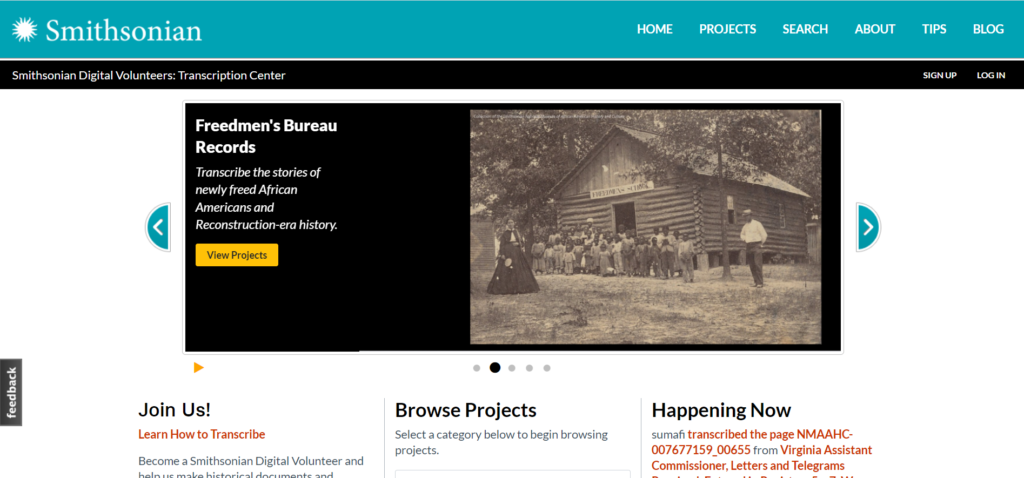
“Smithsonian Digital Volunteers: Transcription Center” homepage, November 26, 2023.
To advertise the program, Smithsonian has created social media pages on X, Instagram, and Facebook, which share updates about the program, the work of the volunteers, and the importance of transcribing these records. There is also some news coverage of the program in the Smithsonian Magazine, WAMU, The Atlanta Journal-Constitution, and others. Additionally, Smithsonian partners with universities and other institutions to complete larger transcription projects, including a Transcribing Club that formed at Youngstown State University to help students earn service hours by transcribing during the pandemic and a partnership between Smithsonian and Hosanna School Museum to transcribe Freedmen’s Bureau records. These strategies have reached several different audiences including college students, retirees, museum professionals, and average citizens.
My Experience as a Volunpeer
Before transcribing a historical record from the Smithsonian, I was instructed to read the “General Instructions for Transcription and Review” to get an understanding of how to transcribe records (2023). The instructions were easy to understand and served as a good reference as I started transcribing documents. There were instructions on how to handle words that were illegible or spelled incorrectly as well as how to use the manipulation tools in their transcription form.
The website offers the opportunity to sign up for an account, but I opted to transcribe anonymously. Signing up for an account has benefits for those who do plan to continue transcribing because it allows users to document the transcriptions they’ve completed and offers the opportunity to be recognized by the Smithsonian. Additionally, signing up means the user agrees to the Community Guidelines, which can result in suspension if guidelines are violated (“Community Guidelines,” 2023).
I then browsed the projects available to transcribe and I thought the process was so simple because users can browse by difficulty level. This allows new users to begin easier projects and more advanced users who can read cursive well or understand how to format a chart can find projects at their level. Since I have years of experience transcribing historical records, I selected a page from the Freedmen’s Bureau records that was listed as advanced.
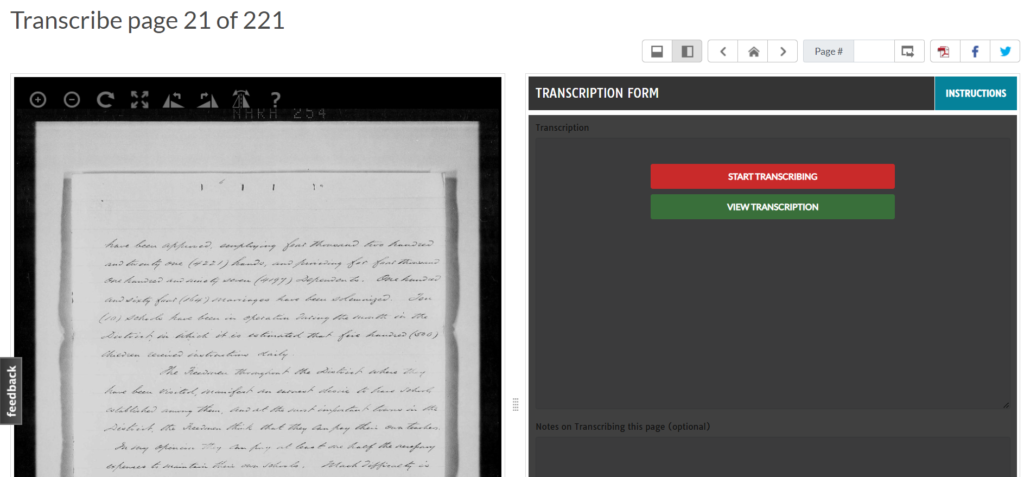
The record and the transcription form appear side by side on the “Smithsonian Digital Volunteers: Transcription Center” webpage, November 26, 2023.
After clicking the collection, I was taken to the next page available for transcription and got started. The document and the transcription box are set up right next to each other and I was able to zoom in to get a closer look at some of the words. Overall, the process was incredibly simple, and it took me just a few minutes to transcribe one page. I did have to refer to the general instructions because I couldn’t remember how many brackets were needed around a word I couldn’t read, so I went back to that page and found the answer “[[?]]”.
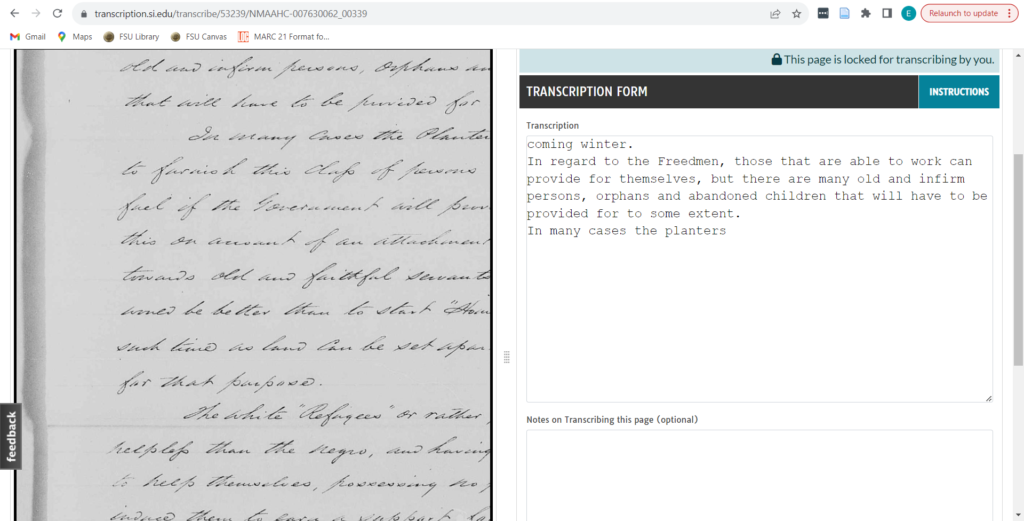
My first transcription in process, November 26, 2023.
After completing the transcription, I clicked “Complete and Mark for Review” so it would go to the next phase of the transcription process. Now, it is up to a different volunpeer to review the transcription before it moves on to a Smithsonian staff member for review and approval. The entirety of the transcription process was clearly identified on the general instructions page. A volunpeer can serve as both a transcriber and reviewer, so had I chosen to review, I would have been checking a transcription submitted by another volunteer. I think this three-step process is an excellent way to ensure a transcription is as accurate as possible and reduces the risk of mistakes or personal information being made available publicly.
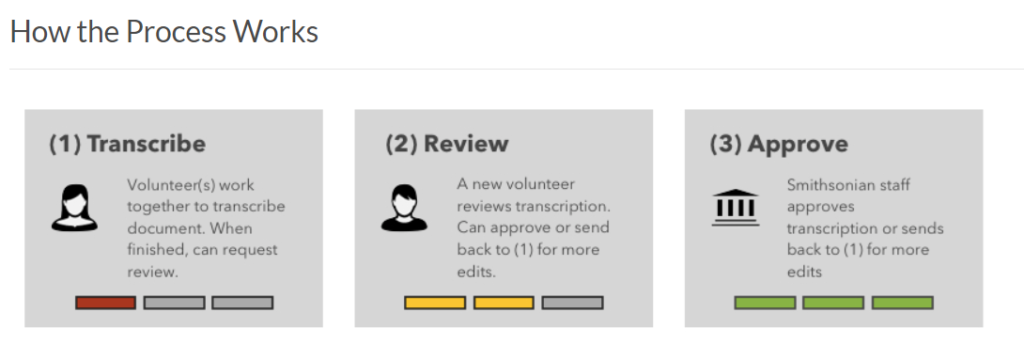
The three step review process of Smithsonian transcriptions, November 26, 2023.
In addition to accuracy, Smithsonian does have a 14 and older age limit for volunteers to create an account. They are, however, allowed to volunteer anonymously. The age restriction has more to do with the collection of personal information. I thought maybe the age limit was related to the mature content that can sometimes be found in historical records, but the risk Smithsonian is attempting to mitigate relates to protecting the privacy of users under the age of 13 years old (“Smithsonian Kids Online Privacy Statement,” 2014).
My experience with the Volunpeer Program was overwhelmingly positive. It was organized and simple to transcribe, which is all you can ask for as a volunteer. The best way to keep volunteers is to make it easy to volunteer. I think in the long-term, this program serves as a good model for other cultural heritage institutions who are currently running digital transcription programs or hope to start one. This program would likely only be possible at a larger institution like the Smithsonian. Our program at the State Archives was on a much smaller scale and we directly interacted with every volunteer. They would transcribe and staff would review, so it was incredibly time-consuming for us.
Future of Museum Crowdsourcing
I think one of the biggest issues museums may face is lack of staff to implement a crowdsourcing program. Despite this challenge, I think there are several benefits to crowdsourcing. People feel invested when they can be part of a crowdsourcing project, which can increase engagement and promote a positive public image for the museum.
Likewise, crowdsourcing can create more accessible collections that make research easier for experienced researchers as well as students and average citizens. As Getty found, people do want to transcribe, and it can become difficult for staff to keep up with the review of content (Deines, 2018).
To mitigate this issue, I’d recommend museums hire at least one designated staff member to implement the program, review transcriptions, recruit volunteers, and maintain relationships with current volunteers. The position can be another branch of the outreach team who work directly to engage citizens in new and exciting ways.
Resources
Deines, Nathaniel. (2018, February 7). Six lessons from our first crowdsourcing project in the digital humanities. Getty. https://www.getty.edu/news/six-lessons-learned-from-our-first-crowdsourcing-project-in-the-digital-humanities/
Smithsonian. (2023). Smithsonian Digital Volunteers: Transcription Center. Smithsonian. https://transcription.si.edu/
Smithsonian. (2014, June 18). Smithsonian Kids Online Privacy Statement. Smithsonian. https://www.si.edu/privacy/kids
Smithsonian Digital Volunteers: Transcription Center. (2023). Community Guidelines. Smithsonian. https://transcription.si.edu/communityguidelines
Smithsonian Digital Volunteers: Transcription Center. (2023). General Instructions for Transcription and Review. Smithsonian. https://transcription.si.edu/instructions

Leave a Reply
You must be logged in to post a comment.