The basics
The concept of citizen science and crowdsourcing data isn’t new, especially in the world of botany, gardens, and herbaria. I started volunteering with the herbaria at Duke University and UNC Chapel Hill back in 2013 and their programs were already quite well established. SERNEC, or SouthEast Regional Network of Expertise and Collections, facilitates collection digitization and volunteer work for many herbaria across the Southeast United States. With over 233 member institutions covering 14 states in the Southeast United States, SERNEC relies on the public to help universities and herbaria digitize their decades (and sometimes centuries) of specimen cards, especially those that may not have the staff/resources to do so themselves.
Though they rely on the public, SERNEC itself doesn’t do a lot of advertising or recruiting – I only know about it because I worked in botanical gardens years ago and fell in love with herbarium work. I think for the most part, they understand that people who want to do this work will find it, whether it be garden volunteers or employees, university employees, or students in botany/biology departments. They also benefit from exposure on the Zooniverse platform (more on that below) and from a relationship with iDigBio, a digital repository for data and pictures of biological specimens. The project likely gets enough interaction and engagement passively, so they don’t need to spend time or money on advertising or solicitation.
Hosting the work
SERNEC hosts individual projects, or expeditions, through their Notes from Nature collection via the Zooniverse platform. It would be impossible to talk about SERNEC without also talking about Zooniverse. Owned and operated by the Citizen Science Alliance, it is headquartered at Oxford University and had over a million registered volunteers by 2014. Zooniverse makes it incredibly easy for cultural heritage and scientific institutions to get help from the public on all sorts of data transcription projects. Or, as they call it, People-Powered Research. SERNEC uses Zooniverse because of how simple and straightforward the platform is. Organizations can build projects for free, within Zooniverse policies, and with many customization options. Registering as a volunteer is very easy and so is finding an expedition that caters to your interests.
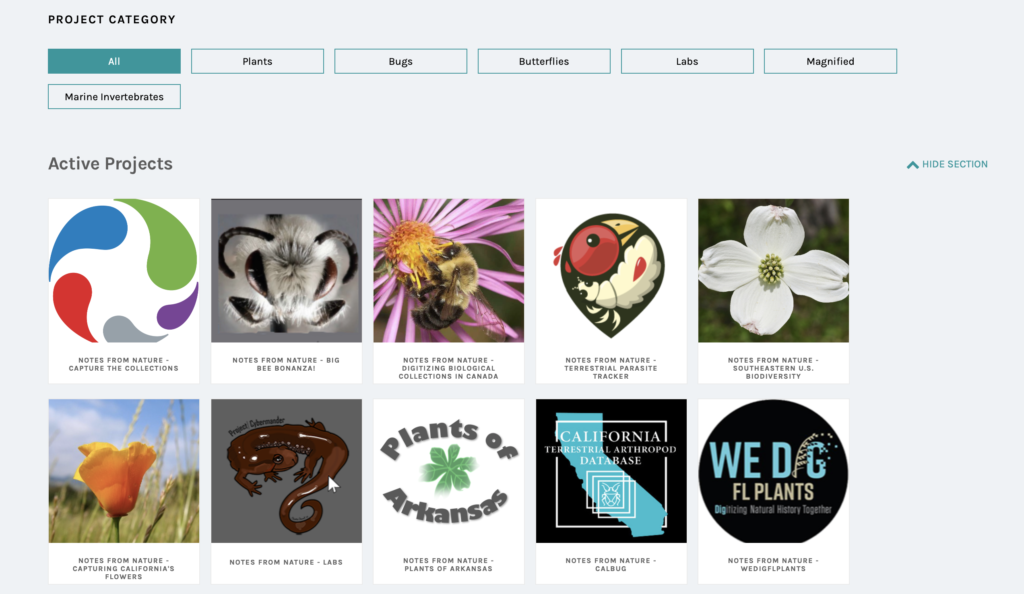
SERNEC itself has two projects available within its expedition right now – Virginia Military Institute Herbarium (VMIL) and Plants of the North Carolina Piedmont. For this post, I’ll take a look at the VMIL project.
VMIL Specimen Card Transcription
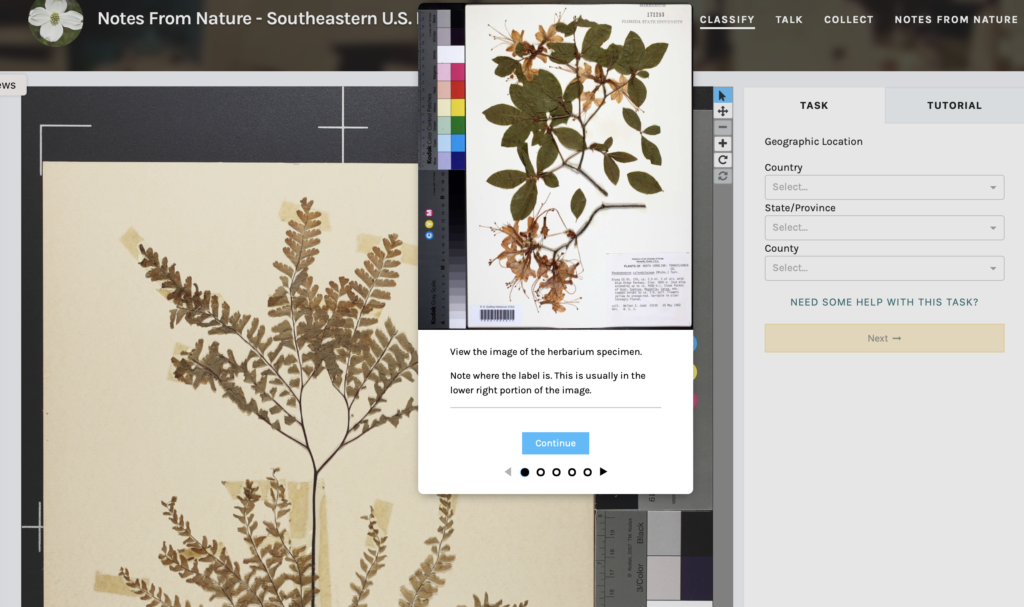
After registering and navigating to the VMIL expedition, getting started is incredibly easy. What VMIL, and just about any herbarium, is looking for is transcription of the collection label. Typically, these will include scientific name, location, a description of the habitat, the collector’s name and number, and a date. Some labels are very basic, some are able to hold a lot of information and details. VMIL created a series of instruction slides that pop up when you first open the project to guide you through the expectations for each field. And, each field has a “Help” button if you need any extra guidance mid-transcription.
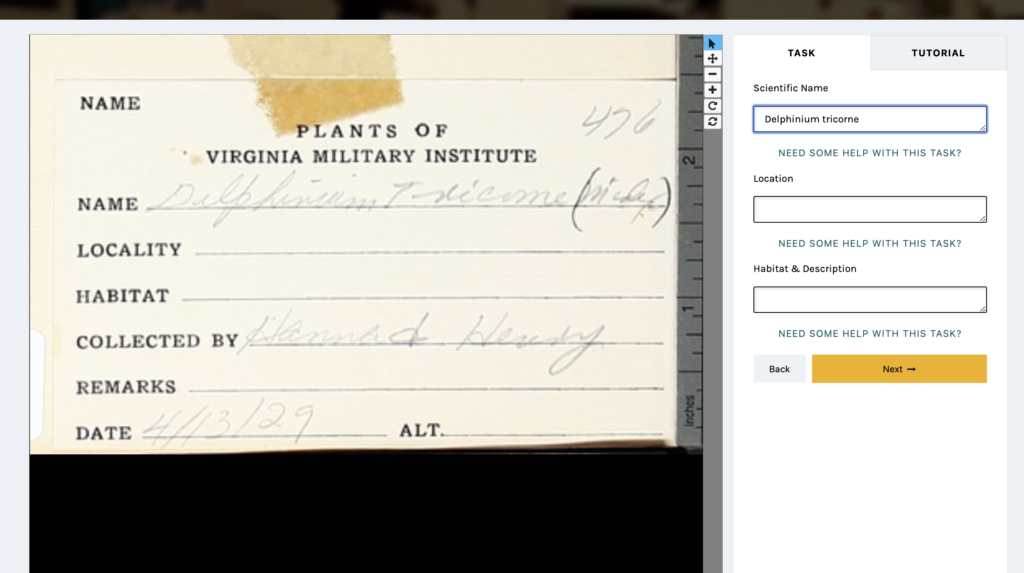
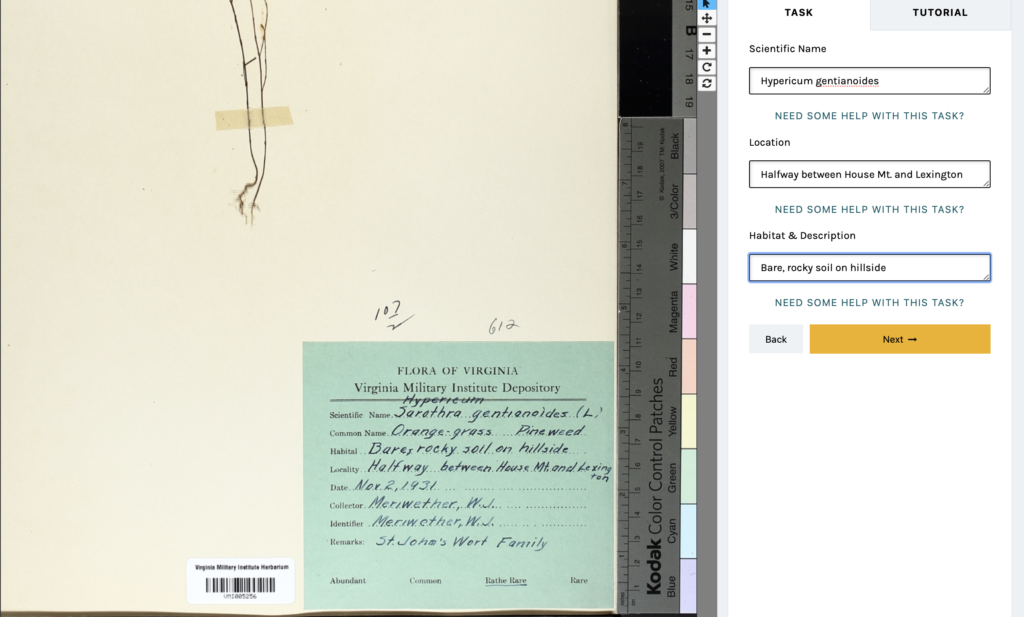
For this project, I transcribed a few specimen labels – two being Delphinium tricorne (dwarf larkspur) and one for Hypericum gentionoides (orange grass). Since the records in need of transcription were originally created as scientific records, the handwriting is often quite legible but I did have to make an occasional educated guess/judgement call; particularly in the Collected By name for the larkspur. One of the more prevalent issues I came across was actually a problem of too much knowledge. Scientific names are not static; they change and get updated as research proves that the tomato is actually part of the Solanum genus, not the Lycopersicon genus. So knowing the current scientific name of plants and seeing old ones on the collection label can be confusing for folks. Most of the time, and this is the case with VMIL, transcribers are asked to not put the current name of the specimen if they know it and type just what the label says. The exception to that is when the specimen has been re-identified on the card and the newer name is available. Then, only that updated species name is entered.
Risk Management
Despite their pressing need for volunteers, SERNEC does take steps to mitigate risks in data quality. You are required to register as a user on the Zooniverse platform – you can fill the form out with any information you want but do have to have access to the email address used to register in order to get started. I imagine this is for a small amount of quality control – if they notice a particular user is not transcribing well or is often wrong, SERNEC is likely able to block them from one of their projects. They offer to credit transcribers in any research papers that may come of this work, so some folks probably want to use their actual name when registering. I don’t know if there is an additional peer review process for these transcriptions – it wasn’t mentioned on the expedition help page or on the actual SERNEC website.
Crowdsourcing in General
I don’t have much personal experience with crowdsourcing in the museum context, outside of the transcription work for various herbaria/SERNEC (and the Ancestry World Archives Project, which doesn’t really count). But, from this limited, experience, I think I can identify a few issues that museums and other institutions might face. Two of the big ones are: continuous engagement and data entry accuracy. It might be easy to get people to try out transcribing, or whatever sort of crowd sourcing the organization is doing, but keeping them engaged sounds like a lot of work. And, to some extent, you have no real control over the quality of the data provided by those who do get engaged. An organization can publish how-to’s, have FAQ documents, and have peer-reviews set up, but there is no guarantee that fixing or approving transcriptions will be a small amount of effort.
On the other hand, folks who do this sort of volunteer work do not tend to be random folks who just stumble in off the street, per se. I think the large majority of folks who provide data to cultural institutions want to do it well, with accuracy, and in a way that adds value. To open data collection/data entry to the public may be well worth the risks that data quality can pose – the margin of error may be worth dealing with to have the benefit of so much work done for free by a volunteer force.
(This isn’t really related to my post, but another great article about how herbaria use Notes from Nature for volunteer transcription work: Community Science Success for Herbarium Transcription in Arkansas: Building a Network of Students and Volunteers for Notes from Nature.)

Leave a Reply
You must be logged in to post a comment.