By: Kendall Millman
Crowdsourcing Project
Budburst is a crowdsourcing mobile application that was created by the Chicago Botanic Garden. The goal of Budburst is to, “bring together researchers, educators, and community scientists to help answer important questions around the effects of climate change on plants and animals—and how we can mitigate those effects” (Budburst, 2021). Once downloaded, the app is extremely user friendly. Through the app, you will use your phone’s camera to take a picture of your selected plant.
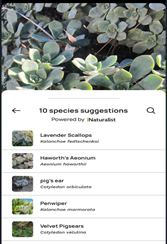
The app makes species suggestions based on the photo, and different options for potential matches will appear. From here, you are easily able to click through the different species to closely compare images and choose the best match. Once decided, the user must determine whether they are making a phenology or pollinator observation.
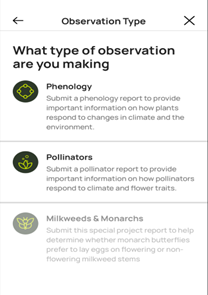
This choice is important because it determines what kind of data is collected. Living in California where it is cold right now, there are very few plants with flowers left on them. With that in mind, I decided to submit phenology observations instead of pollinators. Phenology measures the direct effects that temperature, rainfall, and day length have on plants. These measurements can help show the direct impact that climate change has in these areas. The pollinator observation focuses more on plants with berries or flowers, and how warmer climates affect pollination (Chicago Botanic Garden, 2023). Once observation type is chosen, the location that the plant was found in is verified (screenshot not included for privacy). Finally, depending on what type of plant is found, varying information about the plant phenophases is required.
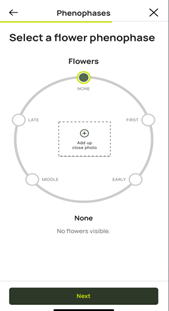
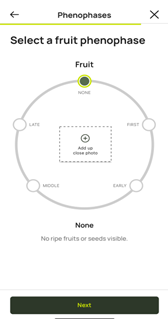
This is where background knowledge and judgement calls must be made. The user must determine if there are any fruits or flowers produced by the plant. This can be especially challenging for non-experts during colder seasons when the plants only have buds. If there are fruits or flowers, the user must determine what stage they are in.
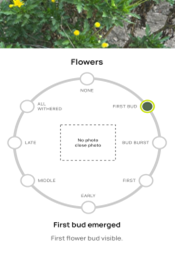
Again, the user must use their judgement to determine the stage of the flower growth. Here, I did have to do some additional research about the correct terminology, and what “first bud” and “bud burst” are. Including an additional close-up photo is suggested to help scientists determine accuracy as they collect the data. However, I could not return to collect a close-up photo of this plant and was still able to submit my observation.
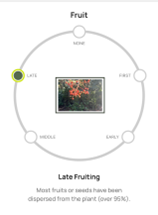
The final bit of ambiguity comes with adding information about fruit present on the plants. The user must determine what season the fruit is in, which may be challenging for people who aren’t experts on the subject. Once you submit your observations you can return to them and add additional information, or another observation of the same plant. This crowdsourcing project was fun and easy and is something that I will make use of this app again in the future.
Audience Participation
Honestly, this crowdsourcing project is hardly marketed at all. I ended up finding out about Budburst through reading a blog post about crowdsourcing in cultural heritage institutions. Even on the website for the Chicago Botanic Garden it is not marketed. I could not find anything about Budburst by navigating through the garden’s website, and instead I had to do a general Google search to take me to the correct page. This means that only people who have previous knowledge about the crowdsourcing project, or those who visit the gardens in person and hear about the project, are really those who are being targeted. This could be beneficial because it would mean that only people who are passionate about the topic are participating. However, this strategy excludes a great portion of users from even hearing about Budburst, let alone contributing observations.
Judgement and Risks
There was quite a bit of ambiguity in the information I provided to Budburst. From the very beginning, I had to choose which plant matched the photo I provided based solely on physical traits since I am a non-expert. Also, I had to make my own judgement and interpretations for the stages of flowers and fruits present on the plant. Most of the ambiguity was surrounding which label was appropriate to choose for each step during the observation.
In general, the Budburst app is safe to use, it but does require individuals to provide some personal information and create a log in. Users must also agree to the terms of service and be over the age of 13 years to join. There is relatively low risk involved in participating in this crowdsourcing project. Individuals need not travel far to take simple pictures and make observations of plants. Once an observation is submitted to Budburst, scientists from all over the world review and interpret the information.
Crowdsourcing in Museums
This was my first time participating in an active crowdsourcing project, and I really enjoyed it. The convenience and simplicity of using a phone application to participate made it extremely accessible and user friendly. Ambiguity in tagging, subjective user interpretation and non-expert user input are all potential challenges that museums can face when it comes to crowdsourcing for knowledge creation. It is important to keep in mind that there is greater risk for the input of inaccurate or biased information by nonprofessionals in the field, which can lead to potentially inaccurate results. Additionally, crowdsourcing has been ethically challenged for the exertion of “free” or “cheap” labor (Agostino, 2015). In general, museums seem to greatly benefit from using crowdsourcing. The physical reach of a project is greatly increased when using crowdsourced data, which means that there will be significantly more data collected. Additionally, crowdsourcing is a great way for museums to gauge user interest in collections and topics (Agostino, 2015). Crowdsourcing projects also help increase community collaboration by connecting institutions and researchers with their communities in a meaningful way. Also, when museums use crowdsourcing for their projects and collections, goals can be met much quicker and public interest levels are increased (Burnett, 2021). Museums that use technology (such as mobile apps) for crowdsourcing projects can engage with a dramatically larger audience. Crowdsourcing can benefit cultural heritage institutions and communities alike.
References
Agostino, C. (2018). Museum crowdsourcing as playful labour. ICOFOM Study Series, 43a, 23–37. https://doi.org/10.4000/iss.545
Budburst. (2021). Chicago Botanic Garden. https://budburst.org/
Burnett, J. (2021). Contemplating crowdsourcing in digital cultural heritage. Cultural Heritage Informatics Initiative. https://chi.anthropology.msu.edu/2021/12/contemplating-crowdsourcing-in-digital-cultural-heritage/
Chicago Botanic Garden. (2023). Budburst. https://www.chicagobotanic.org/research/citizen-science/budburst

Leave a Reply
You must be logged in to post a comment.