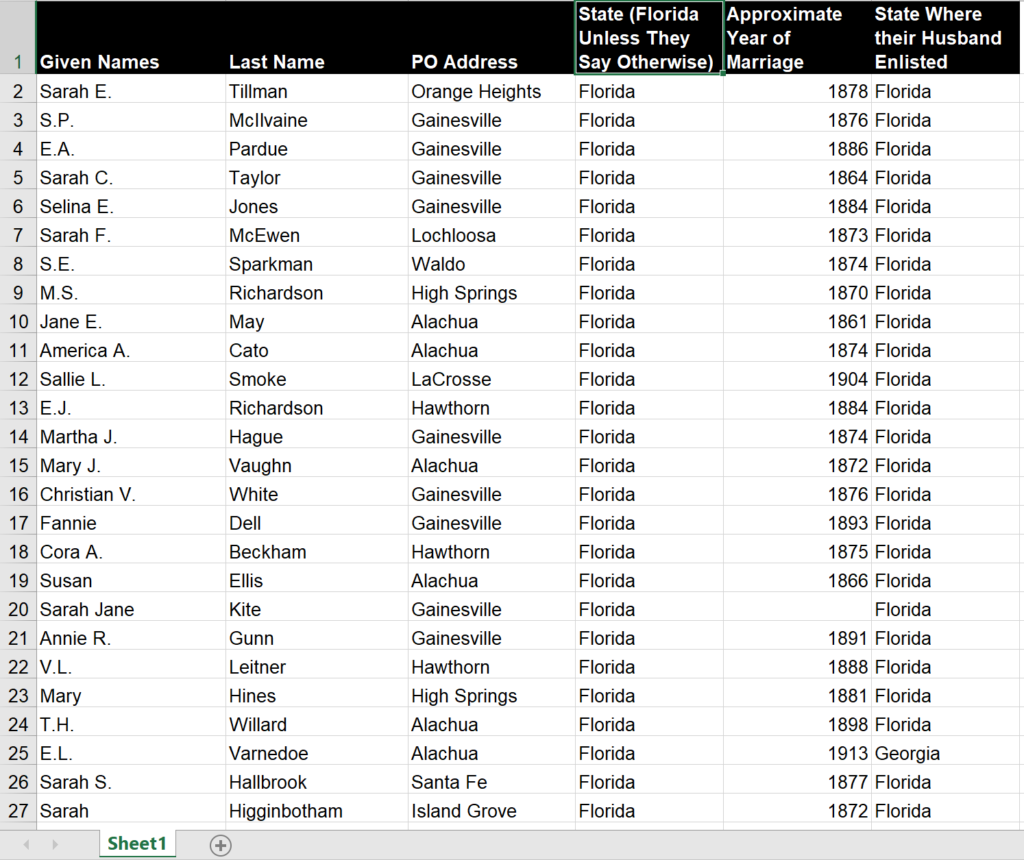
In this reflection, I will be reflecting on my crowdsourcing experience when contributing to the Florida Memory Program operated by the State Library and Archives of Florida (link: Florida Memory). Posted up above is a screenshot of my contribution: transcribing a list of Confederate Widows Pensions made in 1933 and compiling the data into a Microsoft Excel spreadsheet.
The Florida Memory Program encourages participation from the public using three methods: Donation of Records, Sharing Public Knowledge, and Transcribing. When it comes to donating records (link: Florida Memory • Donating to the State Archives of Florida), Florida Memory encourages regular visitors of the Museum and Archives to donate their family papers, photographs and documents to the State Archives of Florida. Regarding sharing knowledge (link: Florida Memory • Photographs), Florida Memory solicits users and visitors to aid in identifying individuals, structures, or events in the photograph collections preserved and digitized by the Archives. For transcribing, which is what I contributed to, Florida Memory solicits user and visitor participation through allowing them to help the Archives transcribe written data from the comfort of their home. Many of these participating users, myself included, were Digital Volunteers and our task was to help transcribe newly digitized collections of letters, diaries and other valuable historical records. No special software was required, and Digital Volunteers can choose from a variety of projects to suit their interests. The Florida Memory Program uses many rhetorical strategies to garner engagement from the public. Within the “Donate Records” page, it starts with Frequently Asked Questions about Record Donations, with the answers they provide inciting public curiosity regarding their personal records. For example, the answer for the first question starts out as such:
“If you have ever looked through old family photos, letters, diaries, sound recordings and other documents to learn what your family was like before you were born, and to help you recall the events of your own life, then you understand how important these records are for preserving your family’s history. In the same way, records such as these can be important in preserving the history of a community, a state, or even a nation, allowing us to learn about life in the past, and allowing future generations to learn about life in our times.”
With this in mind, it is my personal belief that the type of audiences that these strategies would be most effective with are users and visitors who share the Archive’s passion for preserving the historical records and images of their local communities, their state, and even the nation itself in an effort to allow future generations to learn about their history.
Engagement and Risk
I don’t recall there being much ambiguity in the information I provided. My duties as a Digital Volunteer were to transcribe documents for Florida Memory, so it was straightforward for the most part. I did have to make some judgment calls when deciphering some of the illegible wording in the documents. For example, the ink on the list of Confederate widows in 1933 had faded away in some places and I had to either examine it and make an accurate assessment of what the faded word was or leave it blank. I only chose the latter option when the word felt completely indecipherable.
This type of crowdsourcing, or at least the one that I practiced, does come with its own risks, especially when one has the ability to work at home with little to no supervision. On the website, there were no terms and services or log-in page Digital Volunteers could access. Any and all materials given to Digital Volunteers were given via email by supervisors affiliated with Florida Memory. Each volunteer is sent a digitized copy of documents from the archived collections to transcribe, one item at a time, via email by the supervisor. Once the document was fully transcribed in an Excel spreadsheet or Word document, the Digital Volunteer sends the completed form to the supervisor in an email reply. With this in mind, there’s always the possibility that the results made by one Digital Volunteer may conflict with those made by the supervisor. However, I did not encounter that on my end. I also did not have any deadlines, which was advantageous for me at the time due to the intensity of my college coursework at the time. Once I completed transcribing the records into an Excel spreadsheet, I sent it out via email to my supervisor. However, I don’t know if he sent out the completed records for review, as I tried to look for it on the Florida Memory website with little success so far.
Application to Larger Museums
With that said, my experience with crowdsourcing might be limited when put into the context of larger museums, but I can think of many challenges that museums may face with this type of crowdsourcing. However, I also foresee certain changes that have been made or are being made within the Library and Information Science field, which includes museums and archives, that may help to alleviate some of those challenges. Some of the benefits I have seen with my experience is how Florida Memory was lax in deadlines, to the point where there were no deadlines. This can be beneficial for volunteers who may have other priorities yet still want to contribute, or at least it was so in my case as it allowed me to prioritize my coursework, however the lack of such deadlines might encourage digital volunteers to become lax in their duties to the point of potential procrastination. There’s also the lack of dedicated channels in communication, as much of my correspondence with my supervisor was conducted mainly via email. This allows digital volunteers to work with little to no oversight, but it comes at the cost of effective communications, as well as the fact that supervisors may not be able to provide helpful insight without the volunteer attaching their work so far in an email reply.
To that end, museums will need to solve that challenge to this approach to audience engagement and allow for better facilitation of this type of participation. Due to recent events, many museums and archives may already be on their way to doing just that. During the COVID-19 pandemic, many museum and archives staff were forced to work at home and communicate via Zoom and other similar applications to better communicate with each other, their supervisors, and other faculty and staff members. Having dedicated museum staff members and supervisors utilizing Zoom to communicate with digital volunteers, as well as establishing reasonable deadlines to submit their contributions, will allow for more committed engagement from the audience and streamline the process and encourage further participation in the crowdsourcing process.
State Archives of Florida. (n.d.). Florida Memory. https://www.floridamemory.com/
State Archives of Florida. (n.d.). Florida Memory • Donating to the State Archives of Florida. Florida Memory. https://www.floridamemory.com/share/donate/
State Archives of Florida. (n.d.-b). Florida Memory • Photographs. Florida Memory. https://www.floridamemory.com/discover/photographs/

Leave a Reply
You must be logged in to post a comment.