In 2018, the Library of Congress began a crowdsourcing campaign titled “By the People” to commemorate the 155th anniversary of the Gettysberg Address. This project involves volunteers transcribing, reviewing, and tagging digitized pages from the LOC collection. Participating in the project is as easy as visiting this Get Started page and following the step by step instructions.
LOC manages an an entire site and a Twitter account dedicated to the project. There is a forum on History Hub about the project. The project is also listed on JustServe.org. These platforms are some of the ways LOC can garner engagement with the project. Some of the platforms, such as the website and the History Hub forum, are better suited to those who are already aware of the project and are interested in participating. The Twitter account and the listing on JustServe.org would be more likely to introduce new audiences to the project and to make folks interested.
This project allows volunteers to transcribe, review, and tag documents. I decided I would participate by transcribing. I started by creating an account with LOC. This isn’t necessary in order to begin transcribing, but I found that it helps with going back to pages you already started working on. It also keeps track of how many pages you’ve transcribed in total. The collections and documents that need transcribing are organized by what they call “Campaigns”. After making my account, I went to the Campaigns page and selected which campaign I wanted to work on.
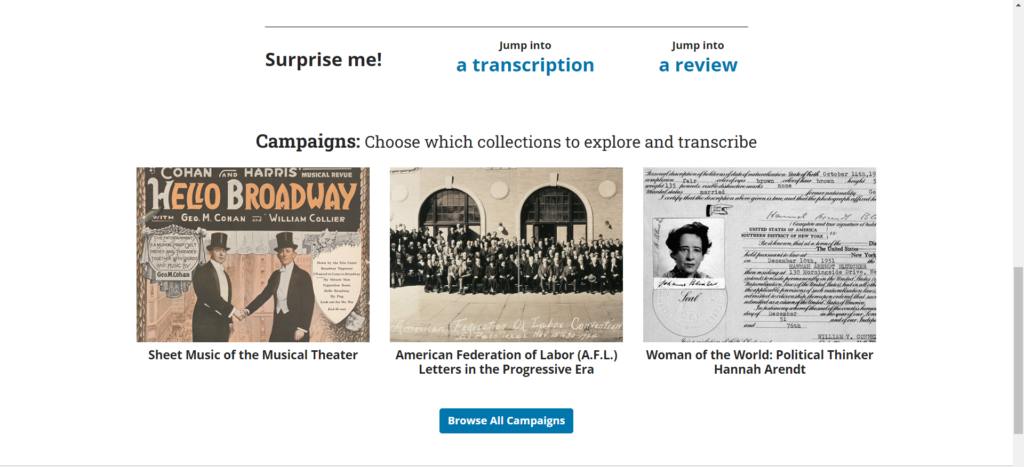
I decided to work on the Sheet Music of the Musical Theater campaign. If you can’t choose where to start, you can also click “jump into a transcription” at the top and it will just choose a document for you. Once you click into the campaign, the documents are further divided. In the case of this campaign, the documents were divided by years.
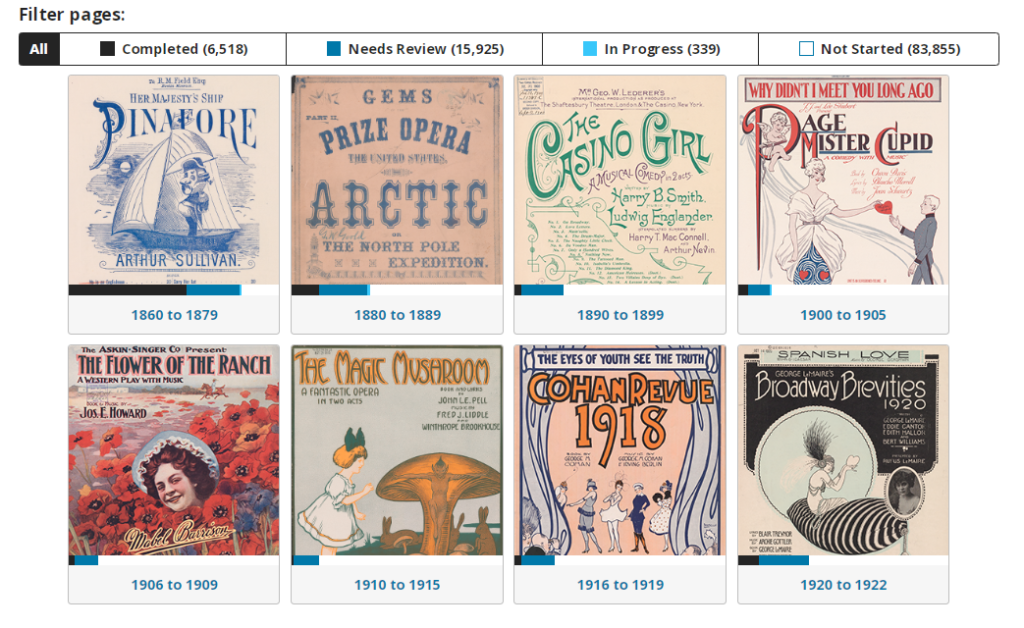
Clicking one of these subsets then shows you the individual pages that need transcribing. When you select a page, it shows the document on the left and a text box on the right.
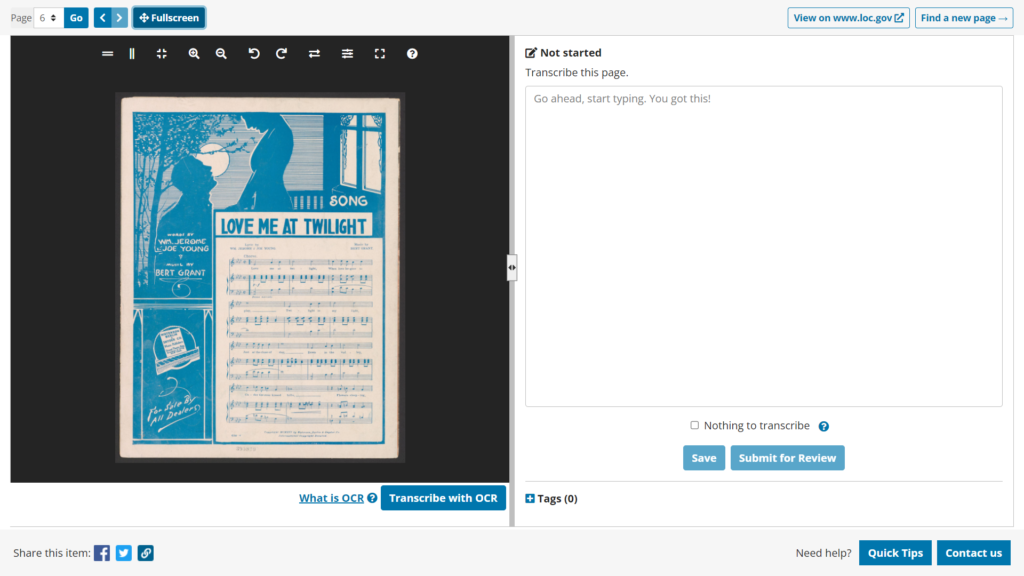
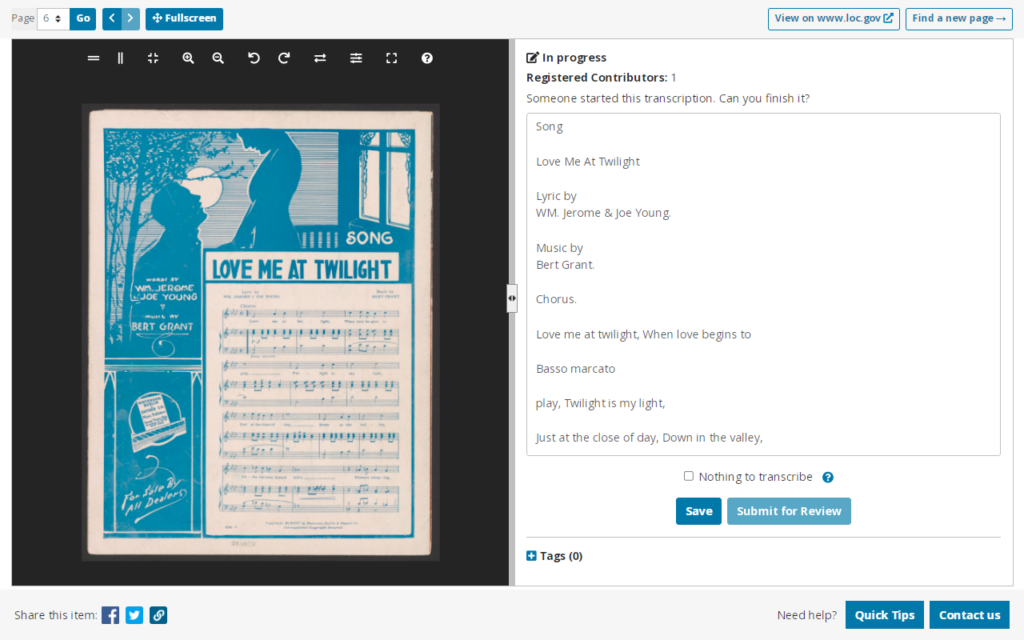
Along with the general transcription instructions provided by LOC, they also provided an illustrated instruction PDF specifically about transcribing sheet music. This was really helpful in showing exactly which parts of the sheet music needed to be included in the transcription.
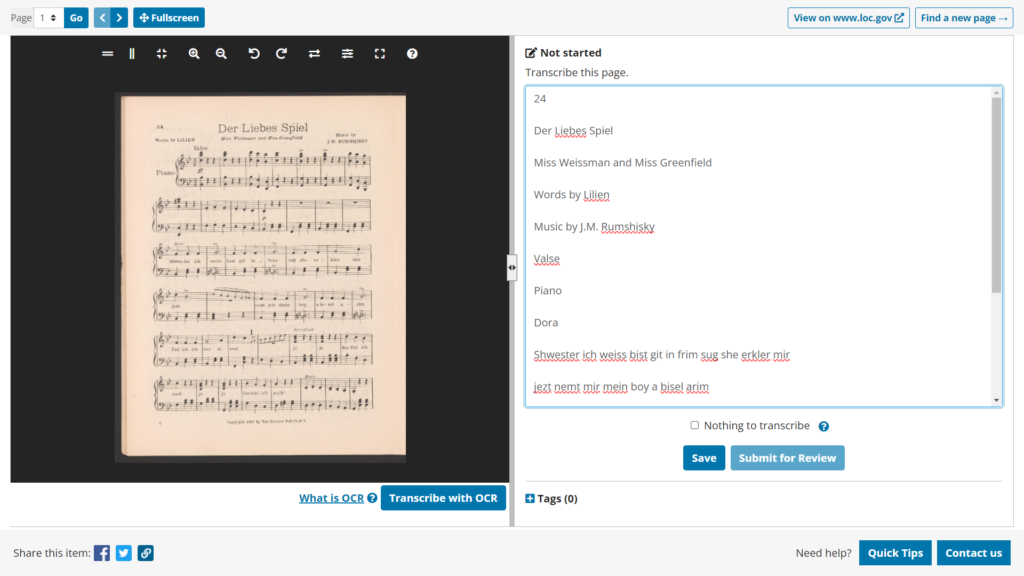
LOC really makes it easy for volunteers to participate with this project. There isn’t a huge learning curve at all. The platform is straightforward and doesn’t require downloading any software. The fact that it’s so easy to participate in the project definitely makes it more likely that volunteers will contribute.
Despite the instructions they provided specifically about transcribing sheet music, there were still a few ambiguous parts that required me to assume what would be the best course of action. I wasn’t sure what order to put tempo markings in. Should it be lyrics, tempo marking, lyrics? Or tempo markings before lyrics? When it came to the headers and footnotes, I wasn’t sure if they should all be on the same line or if each part should be on their own lines. I tried to follow the format of transcription in the instructions they provided as closely as possible. For the documents I transcribed in other languages, I had to make assumptions about whether hyphens were part of the word or part of the sheet music.
LOC implemented a few risk mitigation strategies in this crowdsourcing project. Each document transcription requires review, so after it is transcribed it is sent off for review by other volunteers. As previously mentioned, you don’t have to make an account with LOC in order to transcribe, but you do have to in order to review transcriptions. This ensures more accountability on the part of the reviewer and probably allows for LOC to touch base with reviewers if they have any questions about choices they made while reviewing. Reviewers are not allowed to review their own transcriptions. The History Hub discussion forum also serves as another form of risk mitigation. The forum is a place where volunteers can discuss with other volunteers and with what LOC calls “By the People community managers”.
Crowdsourcing provides an excellent way for museums to gather information about their holdings that they otherwise might not be able to. It also provides participants with a sense of ownership, knowing that they contributed their time and knowledge to the project. In the case of transcription, transcribing documents makes them more accessible by making them full-text searchable and compatible with accessibility technologies. Transcription is a labor-intensive and time-consuming process and museums might not have the capacity to do this work for all their holdings. Using crowdsourcing projects as a way to accomplish these tedious, but necessary, projects can really benefit both museums, patrons, and volunteers.
Despite the benefits of crowdsourcing, it can be difficult getting audiences to contribute their time for free to something that they are not reaping rewards from. Transcription is not the most exhilarating work and knowing that volunteers are not really being rewarded for it might dissuade them from contributing to the project. Museums would need to find inventive ways of persuading audiences to take part in their crowdsourcing projects. Another challenge to crowdsourcing is that participants could be limited by technological barriers. Additionally, implementing strategies for ensuring contributions are actually helpful and accurate could prove to be another challenge for museums.

Leave a Reply
You must be logged in to post a comment.