Revolutionary War Pension Transcription Mission by Alison Simpson
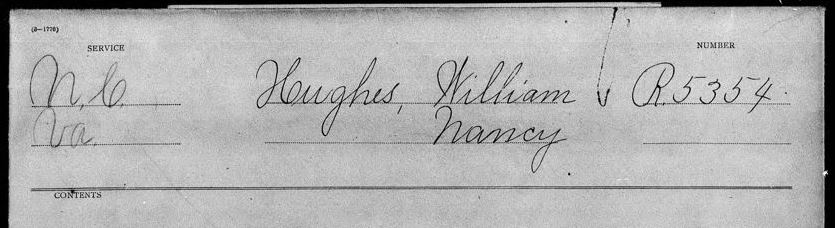
For this assignment, I chose to participate in the National Archives and Records Administration’s (NARA) Citizen Archivist Revolutionary War Pension Files Transcription Mission. (Citizen Archivist Missions, 2017) The National Archives holds over 12 billion pages of paper records, of which 2.5 million images are digitized. The Citizen Archivist crowdsourcing effort began in 2012 and expanded in 2015. By providing the public an opportunity to transcribe, tag, or index resources from a wide variety of topics, NARA appeals to volunteers with different interests and skills and, therefore, increases public access to online records. Volunteers contribute metadata, tags, transcriptions, video subtitles, and digital images on different platforms including NARA’s website as well as Flickr, Amara, Oldweather.org, and WikiProject NARA. (Citizen Archivist Dashboard | Improving Access to Historical Records Through Crowdsourcing | CitizenScience.Gov, n.d.)
With America’s 250th anniversary approaching, the National Park Service (NPS) partnered with the National Archives with a goal to transcribe more than 80,000 pension files of Revolutionary War veterans and widows. While the volunteers for this transcription project must do so via the NARA Citizen Archivists website, the exposure from the NPS website may draw more participants. Volunteers may be counted as an NPS volunteer by adding NPS to their user name when creating the Citizen Archivist account at NARA. (NPS and NARA Call Citizen Archivists to Arms, 2023)
America250 is an initiative to commemorate the 250th anniversary of the founding of the United States. I am a member of the National Society of the Daughters of the American Revolution, a lineage society whose members can trace a direct ancestor who provided military or civil service during the Revolution. The Revolutionary War Pension transcription project appealed to me as a way to learn more about families who had a Revolutionary War veteran and as a way to volunteer my time to promote this period of history in honor of the upcoming anniversary.
In order to participate as a Citizen Archivist, one must first create an account and login. The process to begin transcription was not obvious to me, and I had to consult the directions. Once I realized that you must select a file to learn whether pages of it are still available to transcribe, I selected the first available file titled “Revolutionary War Pension and Bounty Land Warrant Application File R. 5354, William Hughes, N.C. Va.” Of the 28 images, only a few had not been transcribed, so I made an attempt at them beginning with page 18.
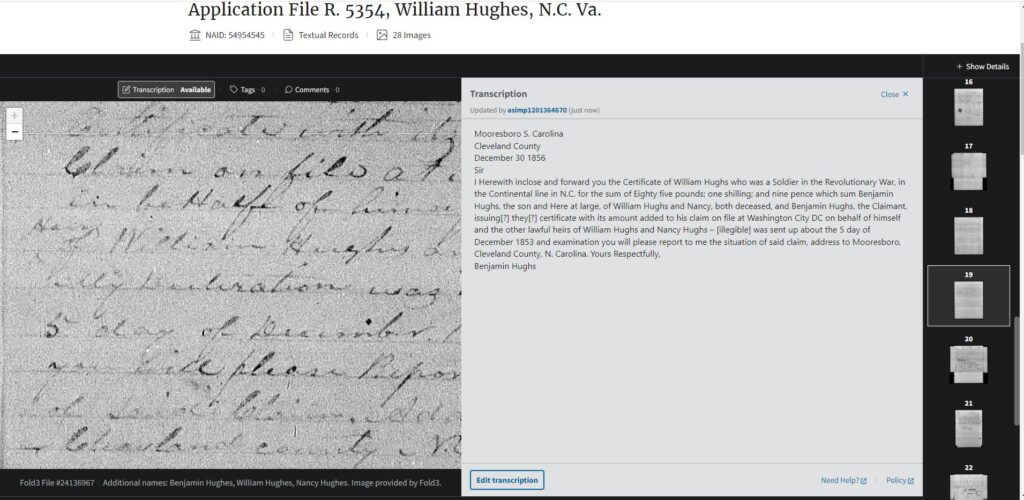
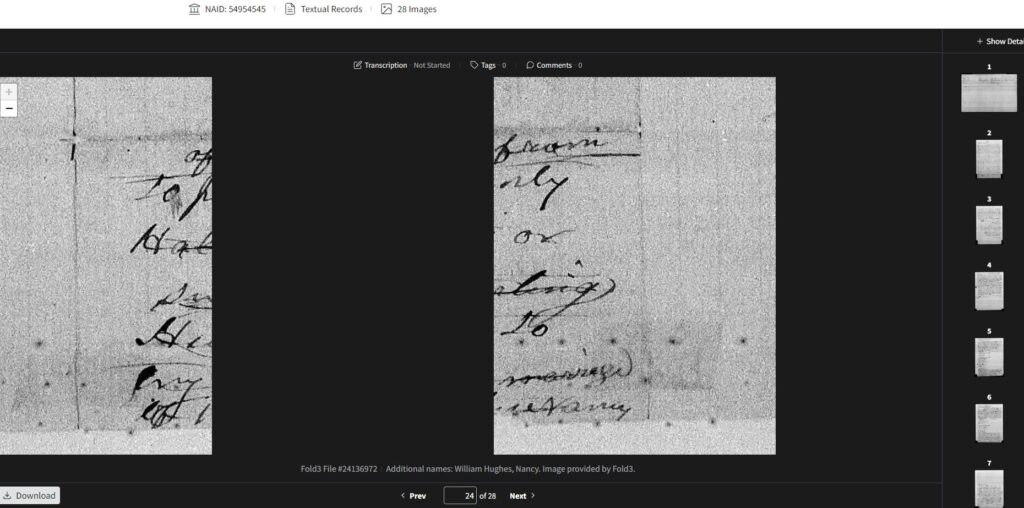
I found that most of the handwriting was legible, and the protocol for transcribing illegible text is to apply the format [illegible] in place of the unknown word. For me, the greatest challenge was the interface with the website when transcribing. The website took a long time to process and save the transcription, and I found that the sections of the zoomed image would not load on the page (see image below). I had to zoom out and try to zoom in again a few times to achieve the greatest zoom on the section of the page I needed to see. I also learned that I was able to edit someone else’s transcription on which I was able to identify a couple of words that they could not. I noticed that only my username was associated with the transcription after updating the edit and could no longer see the original transcriber’s username associated with that document.
NARA selects a wide variety of topics for the Citizen Archivist missions and keeps them open for review and editing for an extended time. It does not select projects that would require significant review by its staff. (Citizen Archivist Dashboard | Improving Access to Historical Records Through Crowdsourcing | CitizenScience.Gov, n.d.) I did not have to sign an agreement or be interviewed or vetted in order to participate. For participants who need help or have specific questions, an online reference blog, History Hub, is available.
The National Archives has a mission to increase public access to online resources. In its 2018 Executive Summary of the Open Government Plan, NARA outlines 10 initiatives to achieve greater public access through innovation. The initiatives include strategies to encourage volunteer participation such as Innovation Hub (a technology lab that allows citizen volunteers to scan original resources), Citizen Archivist, History Hub, and social media campaigns. Working from user data, NARA intends to develop user-generated finding aids and user-centered designs for an updated website at archives.gov. (Open Government Plan | Executive Summary, n.d.)
I feel that smaller organizations, such as museums and archives, may employ the same opportunities for volunteers to identify, tag, transcribe, annotate, index, and translate digitized resources online. However, the museum or archive may find that maintaining the digital archive requires more resources and expertise. If the organization is able to mitigate this kind of challenge, I feel that the benefits of crowdsourcing outweigh the challenges of maintaining the digital archive. Digitization and crowdsourcing is a worthy investment of resources that allows greater access to collections and allows participants to become personally invested. Ultimately, this kind of investment of time and interest would yield a stronger base of support for the organization.
Citizen Archivist Dashboard | Improving Access to Historical Records Through Crowdsourcing | CitizenScience.gov. (n.d.). Retrieved November 26, 2023, from https://www.citizenscience.gov/citizen-archivist/
Citizen Archivist Missions. (2017, May 15). National Archives. https://www.archives.gov/citizen-archivist/missions
NPS and NARA Call Citizen Archivists to Arms. (2023, October 24). American Battlefield Trust. https://www.battlefields.org/learn/articles/nps-and-nara-call-citizen-archivists-arms
Open Government Plan | Executive Summary. (n.d.). Retrieved November 26, 2023, from https://usnationalarchives.github.io/summary/

Leave a Reply
You must be logged in to post a comment.