As Deines (2018) points out in “Six Lessons from Our First Crowdsourcing Project in the Digital Humanities,” there is often a lack of metadata that describes the contents of collections. Art UK seeks to address this by giving registered visitors the opportunity to assign and verify tags for artwork from all over the United Kingdom.
Art UK considers itself “The online home for every public art collection in the United Kingdom,” with the goal of democratizing access to art. From the get-go, the organization makes its approach to soliciting participation clear through the language that appears front and center on the homepage:
Beyond this, however, the participation element is not heavily emphasized; there are no obvious calls to action on the homepage about tagging artwork, though “Tag Artwork” does appear in the navigation bar and as a button on individual art pages.

Art UK’s decision to take a more laid-back approach has two sides: it could make it more difficult to draw visitors’ attention to this opportunity—potentially leading to lower engagement—but it also makes participation seem very easy and low stakes. This is echoed on the main Tagger page, where visitors are assured that “anyone” can tag artwork and that the process is completely safe, given the site’s verification process.
Overall, it seems like these strategies would be effective with all types, including those who may not be as tech-savvy; Art UK makes the process very simple with clear guidance throughout, including a short tutorial for tagging. Participants are instructed at multiple points that they can register to save the tags. Art UK also provides hints throughout the tagging process for additional clarity:
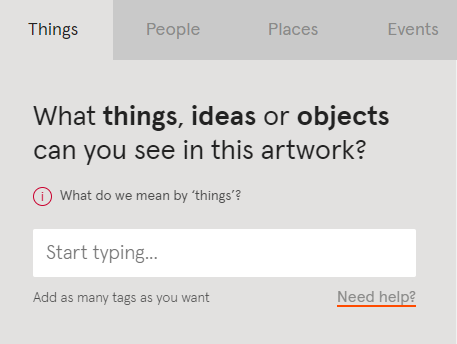
Despite the support Art UK provided, I was initially a little unsure about how specific to be with my tagging efforts; for example, my first artwork was of a ship at sea during a storm and I wasn’t sure if a descriptive tag like “tumultuous waves” would be too much. As you type, the system makes a variety of suggestions that are fairly simple, which made it seem like maybe it was best to avoid adjectives and stick to nouns.
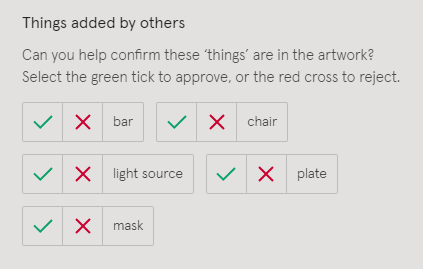
This was reinforced when I saw the tags that others had previously suggested, so that’s how I decided to proceed. I also spent some time verifying others’ tags on a few artworks before I began adding my own, which was helpful in building my confidence. This touches on one of the four considerations Owens (2013) offered in “Digital Cultural Heritage and the Crowd”: the wisdom of crowds, which references our desire to respond to others’ contributions.
Art UK mitigates risk related to this project in several ways:
- All taggers are required to register with the site before their tags will be saved.
- All tags must be verified by two other taggers before they will be approved and officially associated with the artwork.
- Taggers can challenge previously approved tags that they believe are incorrect or inappropriate.
- Taggers can choose whether to make their saved tags and other profile information public or keep them private.
The institution also provides terms and conditions that all visitors must agree to when registering. These terms include in-depth standards for what is and is not allowed to be published on the site, as well as an explanation of how violating these standards can lead to a breach of warranty. While taggers retain ownership rights of content they post, Art UK retains the rights to:
“perpetual, irrevocable, worldwide, non-exclusive, royalty-free, transferable licence to use, reproduce, distribute, prepare derivative works of, display, and perform your content in connection with the service provided by our website and across different media and platforms, including to promote our website and services.”
In addition, Art UK has an extensive privacy policy to protect participants’ information. This policy outlines what information taggers will be asked to provide, as well as what data Art UK collects and what they retain the right do with it—this includes the right to share data with subsidiaries and third parties where appropriate, while providing taggers with the ability to opt-out. Interestingly, Art UK further outlines what type of data it doesn’t collect, such as information regarding race, ethnicity, and sexual orientation. Beyond this, the institution retains a data privacy officer taggers can reach out to with any questions or concerns they have about their data.
This is the first time I can recall participating in something like this. Overall, it was very easy to do given the simple and well-designed system they have in place. There are a lot of benefits I can see to active participation like this, including:
- Increasing exposure to different types of art
- Encouraging viewers to really dig into the art pieces and think about what they’re seeing
- Making art more easily searchable
While Art UK did a great job of making participation less intimidating, some institutions might not be as thorough. As a result, some users may still not feel confident enough to contribute. There also seems to be growing hesitation and distrust when it comes to sharing any type of data online, which is a steep hill to climb. Taking the transparent route will definitely be necessary to encouraging engagement.
Having a gamification component can also help, particularly with younger audiences—Art UK maintains a leaderboard for those who make their tagger profiles public. This relates to Deines’ mention of establishing a sense of community throughout the crowdsourcing project (2018), while also playing off of Owens’ concept of the psychology of participant motivation (2013). Art UK provides taggers with a sense of friendly competition that is directly linked to increased engagement.
Ultimately, institutions should consider following Art UK’s lead by taking a much more active approach to facilitate engagement, while offering plenty of support along the way.
References
Deines, Nathaniel (2018). Six Lessons from our first crowdsourcing project in the digital humanities. https://www.getty.edu/news/six-lessons-learned-from-our-first-crowdsourcing-project-in-the-digital-humanities/
Owens, T. (2013). Digital Cultural Heritage And The Crowd. Curator (New York, N.Y.), 56(1), 121–130. Https://Doi.Org/10.1111/Cura.12012

Leave a Reply
You must be logged in to post a comment.