Which items did you add and how do they relate to each other? (Make sure you provide a link to each item.)
This is a collection of enamel pins that I have purchased at different points of time and currently possess in my home. This collections consists of following five items which I have listed using Omeka under the Ness Goenaga Item Set:
Autumn Harvest Orenba Enamel Pin
Ocean Lover Enamel Pin
Skateboarding Cat Enamel Pin
Seafoam Enamel Pin
Storm Kitty Enamel Pin

What metadata fields did you use to describe your items?
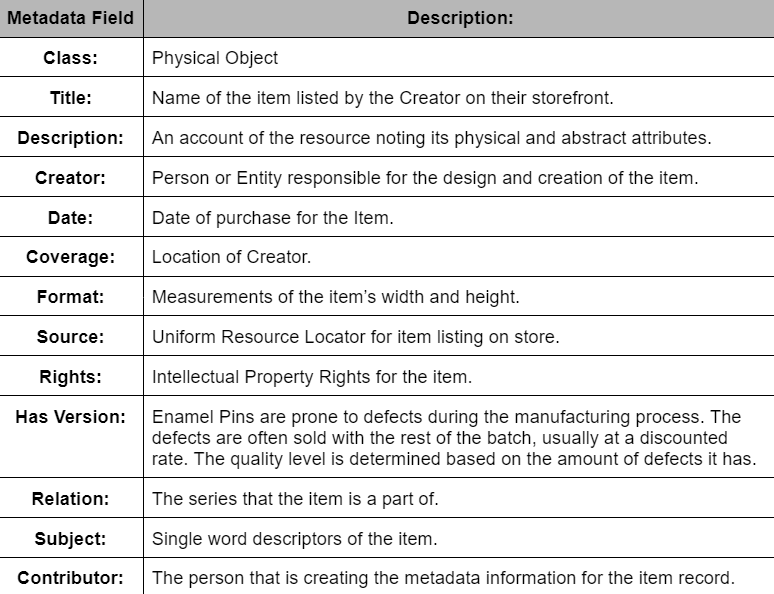
Why did you choose these metadata fields? What function does that piece of metadata serve? What information do you want your audience to take from that piece of information?
I chose these fields based on the information provided to me by the seller of the online store as the purchaser of these items. The most relevant information for locating a specific enamel pin that a person has in mind already would be the creator, title, and series. Creator and series are also good fields to find similar items, if you enjoyed the original resource that you found. If you could find it based on the creator, it would be easy to find an extensive collection of pins for a particular art style. Rights are similar to the creator, but it gives proper attribution towards them. This is also helpful when the rights and creator could potentially differ. It was not the case for these items though.
For a more exploratory search, fields like description and subject can be more beneficial as they simply want to find a pin that fits a theme, topic, color scheme, etc. When searching for pins without a creator in mind, I personally found some of these items using broad search terms such as Ocean or Cat. This could also help with narrowing a search if someone wanted to look for items that pertain only to the ocean and NOT cat or vice versa including both terms.
Other metadata fields provide a better idea as to how the item might appear in person such as format, which showcases the measurements for the item, as the digital image of the item can not convey this information to the user through the screen. Version provides more context also for the item’s appearance, as this determines the quality of the item. The cataloger must provide this. Location is also helpful depending if you want to find all pin creators in a certain area, or if you are just considering shipping costs, possibly if the intent is to buy. Source provides a link to the store where more information can be retrieved about the item.

Address any challenges you faced in describing or selecting these objects. Are there other ways these objects could have been described? What would the impact of that difference be?
If I were to broaden this enamel pin collection, it could potentially have ones that are associated with a specific brand, franchise or company. For example I own many pins that are themed after Pokémon. I considered adding some, but that would require adding two more metadata fields to indicate the additional relation, and the intellectual property rights, possibly changing previous ones to be more specific to differentiate this. This could have also been the case if I wanted to included the manufacturer of the pins as a contributor/ additional spatial coverage. I could have added more specific metadata fields like for the date, since there was also date: created, issued, or accepted as additional options. I kept it simple for now. The more items that could be added the more additional metadata fields would be helpful to better locate the wider range of items within a collection. For the scope of this project however, I just used the most basic information which was provided upon receipt and store information.
Discuss the implications of digital exhibits within the larger context of museums. What new types of audience interaction could exhibits like these facilitate?What challenges do you see in implementing digital exhibits for museums? How do you see museums collaborating in light of these new technologies?
Digital exhibitions provide ease of access to the general public, as not everyone might be able to visit a museum in-person for a variety of reasons: distance, lack of transportation, physical impairments, etc. This has also made it easier to collaborate with museums this way for researchers, students, hobbyists, and educational organizations. Putting a collection within a digital space lets people look through all the items a museum has to offer at their pace. Digital exhibitions can also include aids in the form of screen readers, audio recordings, or auto-translate which might not be possible in-person experience they can have.
Challenges of implementing digital collections would be the extra labor required to create and maintain these systems, and the possibility of deterring visitors from coming to the actual physical library where the items are housed. There is a possibility of information becoming lost, especially with the constant change of systems and the need to update file types and data. Also the additional hurdle of not everyone knowing how to use the technology for digital exhibitions. This is honestly a balancing act where both things need to be intertwined into the other so that each one bolsters the other. The in-person visits should encourage people to go explore the museum catalog online , while the online catalog should promote the exhibitions people would want to go to in-person, and assist them in planning their in-person visit before they go or alert them of news and events to incentivize them to come. The goal of implementing digital exhibits is not to replace the physical library but just to give more options to people and let them know that it is there.
Universities and libraries often pay for databases for students/patrons to access, museums can also fall under this method of placing a fee for access to the digital content if the financials are a concern. Also just the fact that another museum can request access to an item without transporting it and risking destroying a priceless artifact for a special exhibition is great. There is also the added benefit of digital aids actually providing more information and context you would have for a topic than just a document or piece of parchment would like with 3-D models, videos, or audio recordings. In general, museums have more possibilities to communicate and work together to expand, preserve, and share their collection with others through the use of digital exhibits.

Leave a Reply
You must be logged in to post a comment.