Wrapping yourself in a handmade shawl feels like giving yourself a warm hug packed with pleasant memories of past adventures and future dreams to come. Shawls in their simplest definition are little more than some fabric that wraps around your body. This collection of shawls was hand-knitted during the 2020 lockdown – a time when many of us could have used a hug. Everything from the pattern choice to the yarn selection was intentional, attempting to invoke a pleasant memory or dream.
My knitting passion expanded into a love affair with hand-spun and naturally dyed wool after I visited Colonial Williamsburg Weavers Guild in the spring of 2019. My “Williamsburg Shawl” was crafted from yarn spun from the sheep they raised in Williamsburg, VA. It was naturally dyed to present a beautiful yarn serving as a reminder of the beauty one can find in nature.
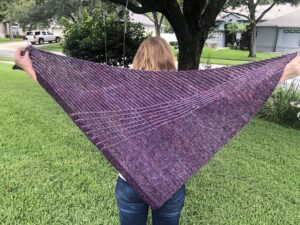
My new-found passion led me to the New York Sheep and Wool Festival in the autumn of 2019. While there, I discovered a hand-dyed “Bumblebee Acres Farm” yarn brand. Their booth was a pure delight, displaying all the colorways named after many of my favorite books like Jane Austen, Harry Potter, and Lord of the Rings. When I wear the “Outlander Gathering Shawl” designed by Bumblebee Acres Farm, made in the Outlander colorway; I return to that special weekend with friends, sharing our love of all things fiber.
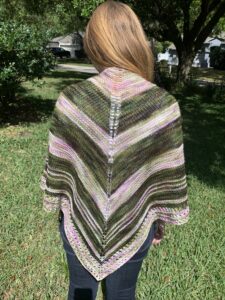
At the same festival, I met Jen Johnson, a Shetland sheep farmer from Whispering Pine Farms. And later, during the lockdown, I longed to make a traditional hap shawl using fine shetland wool from sheep raised right here in the United States. So, Jen and I met on a video chat and I selected her fleeces in fawn, brown, grey, and black; that Jen would hand spin into finger-weight yarn. The special part of this process was knowing each of the names of the sheep who gave their wool for my project. Grudun Johnston is a well-known Shetland designer and her “Hansel” pattern had the traditional shell lace border that perfectly kept with the spirit of this project. The completed Shetland Hap shawl is incredibly soft and it reminds me of the rich knitting history of the Shetland Isles and my love for Shetland sheep – and especially those I know by name!
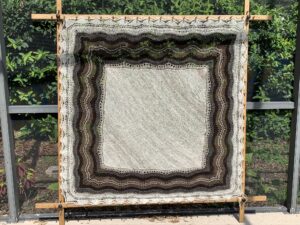
I discovered that Shetland Sheep are on the Livestock Conservation List of Endangered Sheep breeds in the United States. The new goal was to purchase yarn from each sheep breed on that list. The “Blue, Open Water Shawl” was made with Teeswater sheep wool from the critical list. Returning to my love for natural dyeing, I dyed the Teeswater yarn with Saxon Blue Indigo to represent the ocean where we spent much of our time during the summer of that lockdown year.
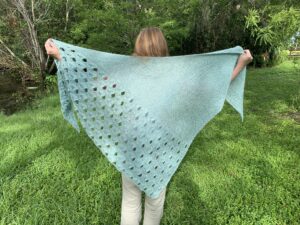
While in lockdown, I dreamt of traveling to faraway places. The “Love of Norway” shawl was a kit I purchased many years earlier when I didn’t have the time or patience to learn colorwork knitting. Cursed with nothing but time, I completed this beautiful landscape shawl full of sheep. It serves as a reminder of a travel-dream yet to come true.
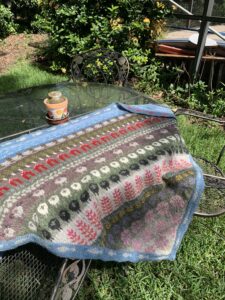
These five shawls make up my collection called “Shawls, A Warm Embrace.”
Selecting the metadata elements to represent these items in the digital collection is just as important as the pattern and yarn selected for the creation of the physical objects. In addition to the three required Dublin Core elements, I decided to add Type, Subject, Source, and Contributor.
All the shawls were Physical Objects under Type. This narrows the objects down in our digital collection to separate digital vs. physical items. Subject ties all my specific items together under the Library of Congress Subject Heading of “Shawl.” This reduces the number of physical objects further to locate all the shawls in our collection.
I used published patterns to create the shawls. It was important to reference the patterns but deciding between Source and Relation elements was difficult. Both are defined as a “related Resource” by Dublin Core. However, the source had an additional explanation of “from which the described resource is derived.” To me, this element seems to give a higher credit to the designer than the relation which merely points to another item. I wanted to link the pattern as a data element with a URL where it could be purchased by others from the designer.
While I was the primary creator of each of the shawls, I felt it important to give credit to the pattern designer and the yarn producers as secondary creators by using the Contributor element. The pattern and the yarn were intentionally selected as tools to create the special shawl. As such, their creators should be given credit in my final product. The use of their creation allowed me to create a unique item to showcase in the collection.
While creating this collection, I was reminded how much I would love to visit the Victoria and Albert Museum, The Shetland Textile Museum, and BOHUSLÄNS MUSEUM which are all overseas. Each holds a unique collection of textiles. Susan Crawford, a knitwear designer, spent years researching objects at the Shetland Textile Museum to create her book “The Vintage Shetland Project.” Those pieces are restricted to people who can travel in person to see them. With financial limitations, digital exhibits are ideal for experiencing the collections from faraway places. Larger museums with more funding can offer a robust website hosting images and descriptions of each of their items like V&A. The V&A also produces YouTube videos that take you inside their world as well. However, smaller museums like the Shetland Textile Museum and Bohuslans Museum, do not seem to have the funding, or maybe elect not to have a digital representation of their collections, even though the technology exists to make it a reality. A digital collection has a cost associated with it and you need volunteers or employees who have the technical abilities to put the collections together.
There are platforms today like Patreon, Substack, and Instagram that have paid subscriptions for content from writers and artists. I wonder if a similar model could work to fund a museum’s digital collection. I know “I” would be willing to pay to see a new item once a month from the museum and learn more about its history. There is still so much I want to learn about the history of knitting, wool production, and natural dyeing. Digital museums and libraries can open many more resources for that learning to take place. In a way, it allows a digital user to embrace the textiles just as my shawls embrace me with all the things I have learned so far, and still dream of learning in years to come.

Leave a Reply
You must be logged in to post a comment.