By Vashti J.T.
Part 1: Image of my work
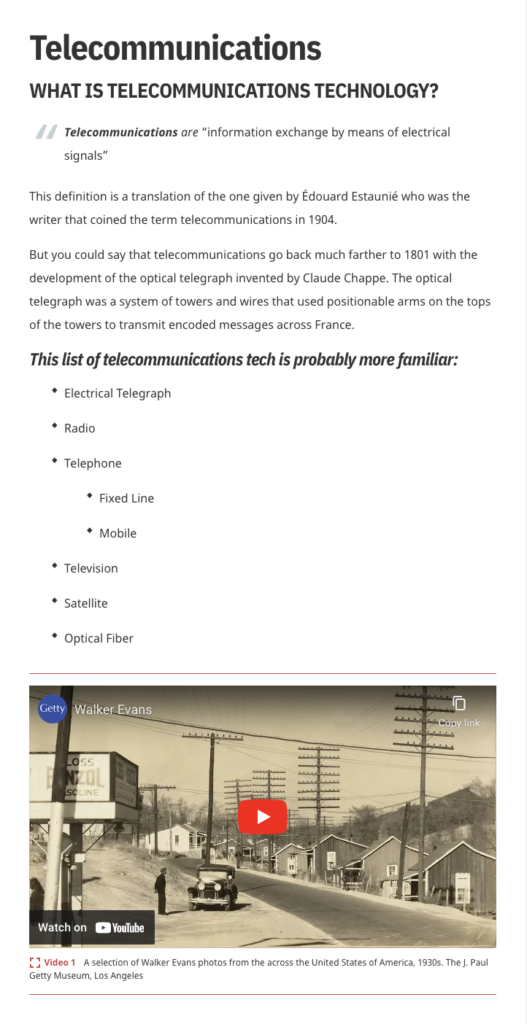
Link to Page: https://lis5590.create.fsu.edu/quire/taylor/
Part 2: My challenges
The initial challenge of using quire, learning markdown and YAML, was the reason I decided to experiment with this tool. Both are very human-readable and beginner friendly. The main challenge was finding out which aspects of quire and YAML were applicable in quire. I found conflicting information about the Github flavor of markdown online (mostly on blogs and social sites) but this was easy to correct as I tested different methods myself and because there was a lot of information shared freely online about markdown. I decided to use as many features of Quire as I could think to use on one page. The results were simple but satisfying.
- Different Level headings
- Block quote
- Citation
- Embedded media
- Bulleted list
- Bold and italic text
My favorite guides were recommend by Getty on Quire’s website itself especially “Getting Started with Markdown” by Sarah Simpkin . I liked reading through Quire’s support community but many of the questions and guides there were for more advanced issues than what I was dealing with. I took Getty’s advice and committed my small changes regularly. Each time, I received an error from Quire that my build had not properly deployed. It made me uncertain of whether my changes were actually going to actually achieve the results I wanted. For example, I used HTML to change the color of the title text to magenta, but because Github preview did not show color, I could not be sure whether the code would actually work in a quire publication (It only worked in part so, I removed it from the final version of my page). This problem is most likely peculiar to my limitations editing only in GitHub without access to deploy my changes.
Part 3: The benefits of Quire
Quire bundles several tools together so that users do not have to worry about the framework they need to create a publication, only the content and style. This allows LAM professionals to focus on their main goals of scholarship, outreach and the creation of educational resources. After viewing the example publications that Getty features, I agree with them that the publications made in Quire have clean feel that allows for a book-like but sleek experience. There is an almost crispness to the lines of text, default fonts and scrolling that reminds me of the glossy clarity of museum catalogs which is what Quire was originally built to create. Quire publications would be very friendly to audiences, making them feel that the information is easy but also enjoyable to browse. They are similar enough in quality to the type of publications audiences expect from LAM institutions. Audiences would likely appreciate them enough to use in all the multiple form Quire enables, maybe even leading them to purchase the publication if offered. Therefore, it is a very good expansion or replacement for the publication formats an institution might use.
Part 4: Challenges of implementing Quire across museums
The video, “Quire: Getty’s Open Source Digital Publishing Tool“ presented by Erin Cecele Dunigan, mentioned backing up the multimedia forms used in a digital quire presentation. As an example, she suggested that content that showed as a linked video in the digital version may show as a still image in a print version. As 3D images are set to be introduced to quire, one limitation for institutions that plan on publishing in multiple formats may be that there is not yet a plan for printing 3d data from their digital version. Similarly, even though videos already have a suggested workaround to use a still image stand-in, I imagine any audio of the video would be lost when being converted. A simple solution that would work in most cases would be that the publishing institution create a version of their publication that uses a transcript of the audio content alongside the still image. But it seems that for now, as the base of publications built with quire is still growing, a museum may have to think of similar workarounds for other scenarios that have not been encountered yet by other users.
Maybe, I am still misunderstanding how quire works but the same trait of locally stored files that serves as an advantage can also be a disadvantage. Quire seems to elegantly solve the issue of collaborating on static published sites on local storage. However, as institutions create more publications through Quire, they will have to develop a system for storing the data in a way that remains accessible to the institution. These sites are only as permanent as the devices they are hosted on. Whatever devices hold the files must be managed or added to the institution’s permanent collection and maintained in order to keep the digital files usable. A print version of the publication will likely fit easily into the traditional storage practices of any institution that creates publications, but digital publication will probably require them to create new procedures.
The final limitation I foresee is that because Quire is a bundle of tools, some institutions may be resistant to adopting it as a whole. They may be intimidated to download and learn how to use all the component parts. Others may be more confident and wish to develop their own processes by choosing combination of tools with similar capabilities. I think the results of Quire speak for themselves. If Institutions want publications in the style and format that quire offers, they will take on the relatively small learning curve to start using it.

Leave a Reply
You must be logged in to post a comment.