For this project, I experimented with IIIF and Exhibit.so and attempted to use them to create an exhibit of my item set from the Digital Objects assignment. Initially I found myself feeling daunted by the task, since I have not had much experience with digital systems and exhibits such as these. In particular, the concept of an IIIF Manifest intimidated me at first. I have never been particularly technologically savvy, so I found it difficult to fully understand the purpose and function of the manifest. However, upon re-watching class, doing some further reading, and continuing to experiment on my own, I have become a lot more comfortable with the practicality of IIIF manifests and how I can utilize them in my career, even if I do not yet have a thorough comprehension of them.
My first step in this project was to retrieve the IIIF manifests of the items in my collection. This process turned out to be much simpler than I had anticipated, with my only issues being my own typos in the URL. Once I realized my mistakes, the images rendered clearly and I was able to locate the IIIF manifests quite easily.
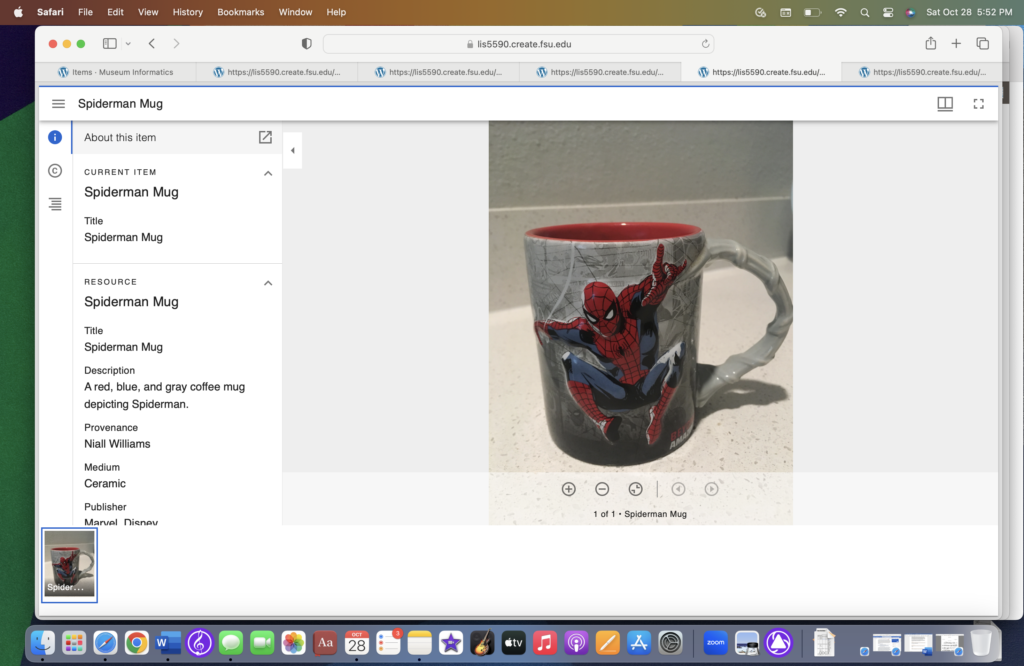
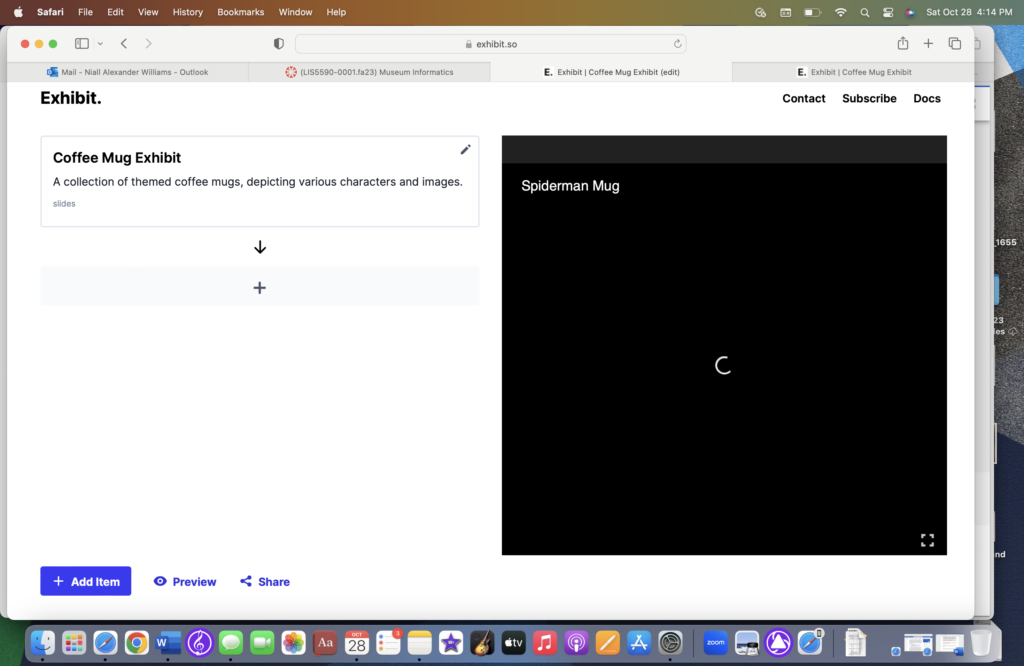
However, my most significant challenges began when I tried to import the manifests into Exhibit.so. Initially, I had been excited to play around with Exhibit.so because of its straightforward interface and aesthetic possibilities. I completed the beginning steps of adding a title, description, and author to create the exhibit, but when I tried to import the IIIF manifest of the first image, it would not load. I waited several hours in the hopes that it would load eventually, but that was unsuccessful, so I then tried several times to reload the page and recreate the exhibit from the beginning. Once that also failed to load, I then broadened my uses of browsers, devices, and Wi-Fi connections to eliminate the possibility that this was solely an issue with my laptop or with my apartment’s Wi-Fi. Over the course of several days, I recreated the exhibit multiple times, on desktop and mobile devices, using Chrome, Firefox, and Safari, as well as on four different Wi-Fi connections. After trying all of these to no success, I felt safe in coming to the conclusion that the technological issue lay with Exhibit.so itself rather than any external factors.
Conceptually, Exhibit.so would be a fantastic tool for institutional and individual use alike. An accessible, freely-available digital exhibits system with easy-to-use interactive features for both creators and viewers has the potential to broaden the scope of museum and archival interaction between patrons/visitors, artifacts, and the cultural context and history behind them, as well as open a space for non-professionals to learn through the process of creating their own exhibits. The various design features available on Exhibit.so offer a diverse range of possibilities without overwhelming the user, and I also found them very enjoyable to experience when viewing some of the previously created exhibits, such as those about Jane Austen and the Qing Dynasty Life and Culture.
However, none of these possibilities may be realized when the system itself is unreliable. A common phrase people use when referring to freely accessible resources is “you get what you pay for,” but in my opinion this does not need to be the case. It is unacceptable to settle for providing a poorer quality of information and resources for one subset of the population than another, and I think it is perfectly reasonable to expect accessible digital systems to be well-functioning and of high quality. This is especially the case when it comes to museums, archives, and libraries, whose primary purpose is to house information and resources and ensure that they are made as freely available to the public as possible.
Ultimately, Exhibit.so will have great potential once it is developed further and its quality becomes more consistent. As an online resource, those without access to reliable devices and internet connection will still be unable to benefit from it, though overall it will expand access to museum resources for individuals, classrooms, and institutions. It also has the opportunity to provide a standardized framework for the creation of digital exhibits, which would benefit museum professionals across institutions, reducing the need to learn multiple different systems to the same purpose, as well as offering opportunities for professionals across institutions to collaborate with one another in the creation of resources.

Leave a Reply
You must be logged in to post a comment.